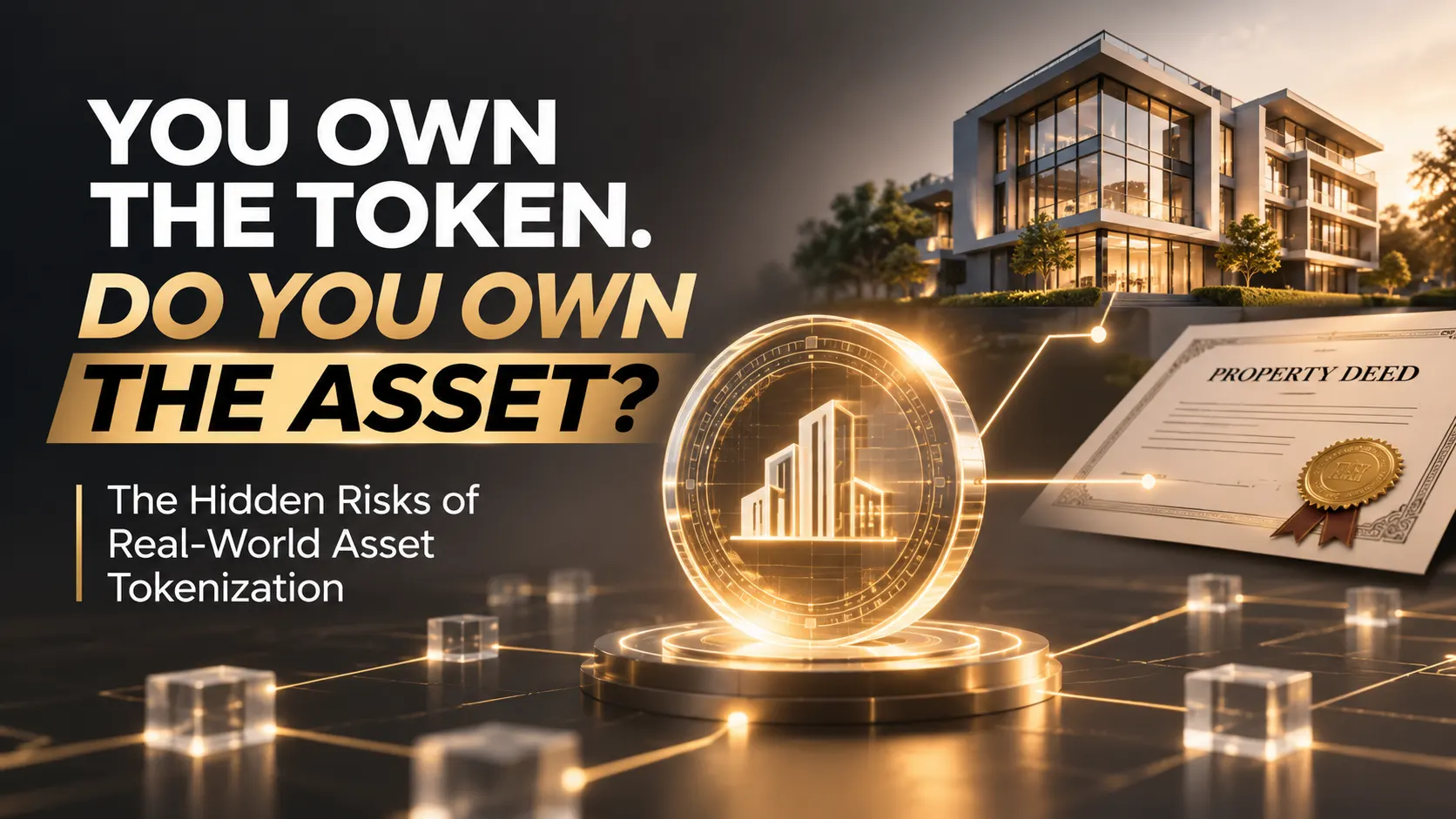
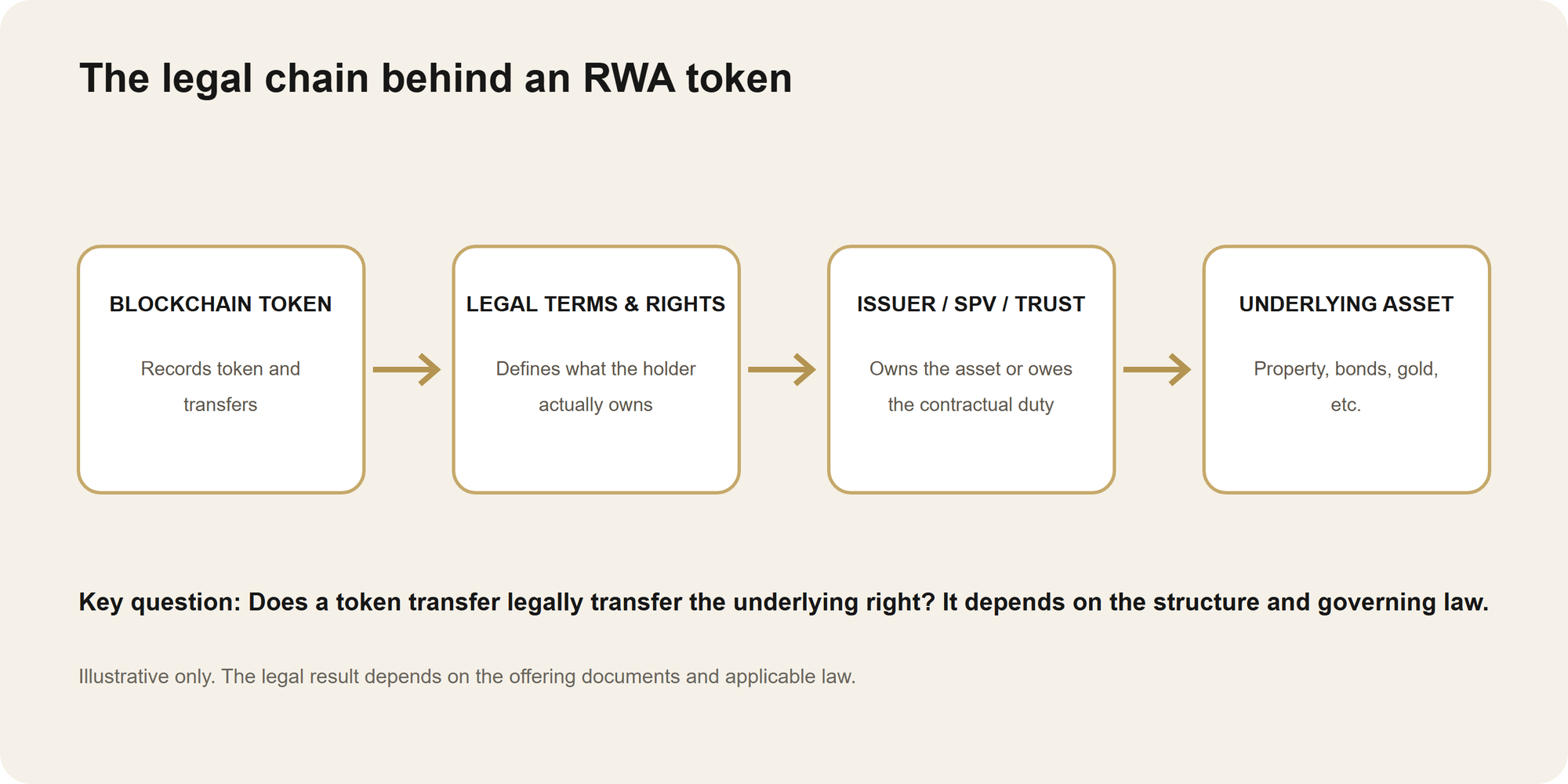
A token can be visible on a blockchain, transferable between wallets and supported by an audit trail. None of those facts, on their own, proves that its holder owns the property, bond, fund interest or other real-world asset the token claims to represent.
That distinction is becoming more important as financial institutions explore tokenized bonds, funds, private credit, commodities and property. Tokenization can improve recordkeeping, automate parts of the transaction lifecycle and make fractional interests easier to distribute. But it can also make a complicated legal arrangement look deceptively simple: a token appears in a wallet, so an investor assumes the underlying asset belongs to them.
The critical question is not merely whether the token exists. It is what enforceable rights the token gives its holder, against whom those rights can be enforced, and what happens when something goes wrong.
The International Monetary Fund's October 2026 Global Financial Stability Report (opens in a new tab) identifies legal certainty, regulatory clarity, interoperability and safe, scalable settlement as key constraints on tokenized markets. The IMF stresses that the legal framework needs to establish clear rights over tokens and underlying assets, and to recognise on-ledger transfers and settlement finality.
This is the central issue that tokenization marketing can obscure: a digital record is not automatically a legal title deed.
The core principle: Blockchain can help prove what was recorded and when. It cannot, by itself, determine the full legal meaning of that record.
 (opens in a new tab)
1. What does an RWA token actually represent?
Real-world asset (RWA) tokenization uses distributed ledger technology (DLT) to issue or represent digital tokens linked to assets or financial rights that exist outside, or are legally defined beyond, the token itself.
The phrase “backed by an asset” can describe several very different arrangements:
- Direct or legally recognised ownership: The token and the relevant legal system work together so that holding or transferring the token conveys a defined ownership interest.
- Shares in a special-purpose vehicle (SPV): The investor owns shares in a company that owns the asset. The investor does not necessarily own the underlying asset directly.
- A fund or trust interest: The token represents units, shares or a beneficial interest in a fund or trust, subject to its governing documents and applicable law.
- A contractual claim: The issuer promises to pay, redeem or deliver value under a contract. The holder may be a creditor rather than an owner of the underlying asset.
- A synthetic or price-linked exposure: The token tracks an asset's price or performance without necessarily conveying ownership of that asset.
These structures are not interchangeable. The exact legal outcome depends on the token's terms, the issuance and custody structure, the relevant asset law, and the jurisdictions involved. The Bank for International Settlements (opens in a new tab) describes tokenization as combining a core layer of information about an asset and ownership with a service layer that embeds rules and governance. The legal and technical arrangements therefore matter as much as the token interface.
A marketing page may say “one token equals one square metre of property” or “fully backed by gold.” Those phrases are incomplete until the documents explain whether the holder owns a fraction of the property or gold, holds shares in an entity that owns it, has a redemption claim, or merely has contractual exposure.
The five common rights structures
| Structure | What the holder may have | The question to ask |
|---|---|---|
| Direct asset interest | A legally recognised ownership interest, if the governing law and registry arrangement support it | Does transferring the token legally transfer the asset interest? |
| SPV equity | Shares in a company that owns or leases the asset | What happens to the company's assets and liabilities if the SPV fails? |
| Fund or trust interest | Units or a beneficial interest governed by fund/trust documents | Who is trustee, custodian or manager, and what are the redemption rules? |
| Debt or contractual claim | A right to payment, redemption or performance from an issuer | Is the claim secured, senior, subordinated or unsecured? |
| Synthetic exposure | Economic exposure to a price or index | Is there any claim to the underlying asset at all? |
This table is a conceptual guide, not a legal classification for any particular token. Investors should read the offering documents and obtain jurisdiction-specific advice where material.
2. The blockchain record and the legal record can be different things
Consider a hypothetical token representing an interest in an office building.
A smart contract may record that Wallet A transferred 100 tokens to Wallet B. The transaction can be independently verified on the blockchain. But does that transfer update the land registry? Does it transfer shares in the company that owns the building? Does the issuer's register of investors also need updating? Must the transfer be approved by a trustee, registrar, administrator or regulator?
If the legal structure says the token is only a digital representation of a separate right, a blockchain transfer may transfer the token without automatically completing every legal step required to transfer the underlying right.
This is not an argument that tokenization cannot work. It is an argument for aligning the technical system with the legally authoritative records and transfer process.
Malaysia's Securities Commission (SC) makes the distinction explicit in its FAQ on tokenised capital market products (opens in a new tab). It says the rights attached to the token, the token architecture, smart-contract functionality and governance mechanisms matter. If token rights differ from those of the traditional underlying product, the legal characterisation may change. The SC also identifies legal enforceability, ownership provenance, transaction finality, disclosures, cyber resilience, lifecycle governance and AML/CFT as risks that capital market intermediaries must identify and address.
Practical test: Ask the issuer to show the legal mechanism connecting the token to the asset. Do not accept a blockchain explorer screenshot as a substitute for that explanation.
3. “Backed by an asset” is not the same as “protected by an asset”
Asset backing is often presented as if it settles the risk question. It does not.
Suppose a company issues tokens said to be backed by a warehouse worth RM50 million. The warehouse may exist, and an independent valuation may support the stated value. But investors still need to know:
- Who legally owns the warehouse?
- Is it subject to mortgages, liens, leases or other claims?
- Is the token issuer the owner, or is the asset held by a separate entity?
- Is there a legally enforceable trust, security interest or other arrangement for token holders?
- Are the assets segregated from the issuer's own assets?
- Who can enforce the rights if the issuer defaults?
- Can the asset be sold, and how are proceeds distributed?
- Does the token holder have direct recourse to the asset, or only a claim against the issuer?
A valuation tells an investor something about estimated value. It does not, on its own, prove ownership, priority, segregation or enforceability.
This distinction is especially important when the marketing phrase “asset-backed” is used without explaining the holder's legal position. An asset can support a business economically without being legally ring-fenced for the benefit of token holders.
 (opens in a new tab)
4. The insolvency test: what happens when the issuer fails?
The most revealing time to evaluate a token's legal design is not during a bull market. It is when an intermediary fails.
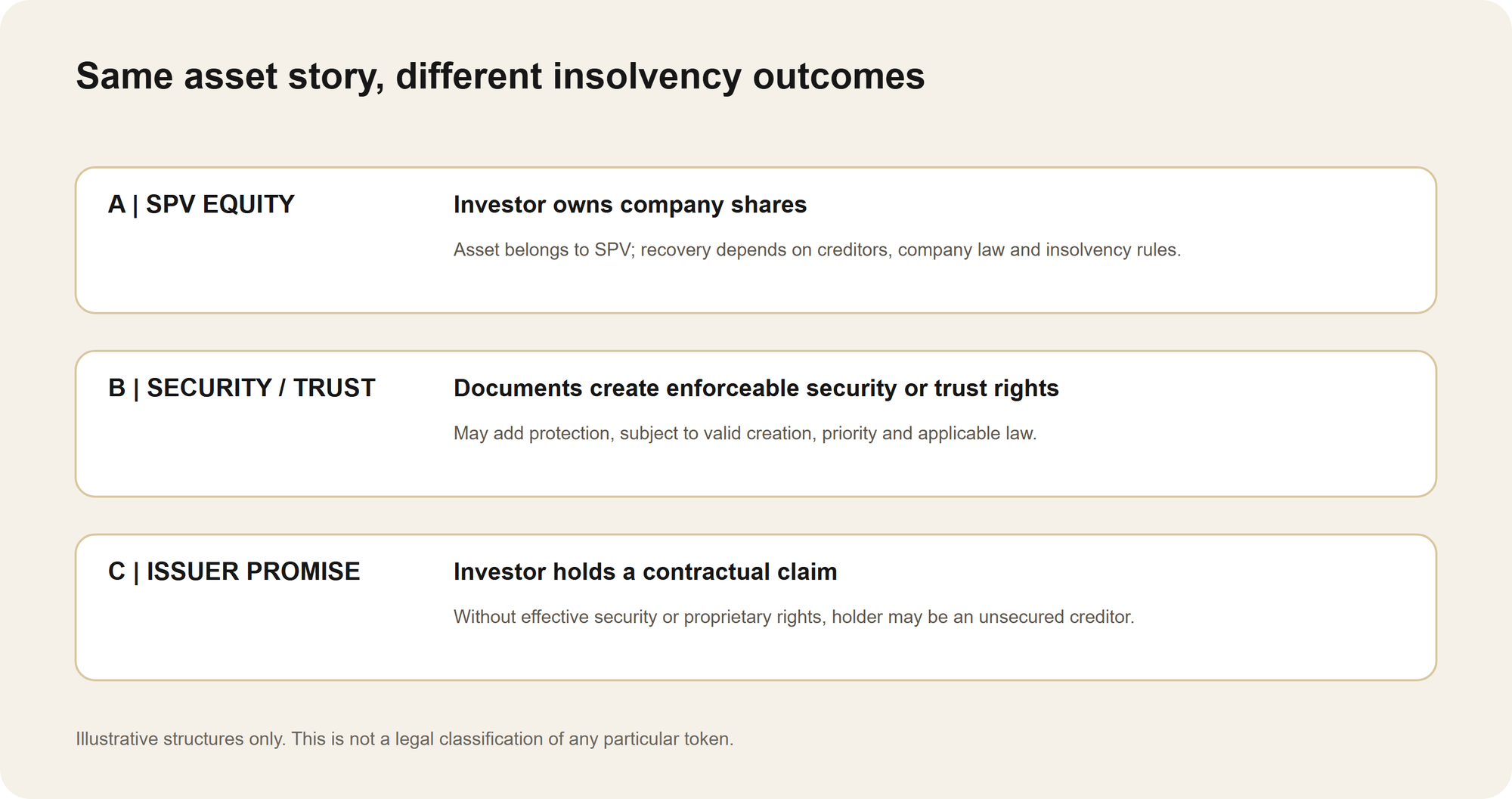
Imagine three versions of the same property token:
Version A: Tokenised shares. The investor owns shares in an SPV that owns the property. If the SPV becomes insolvent, the property is part of the SPV's estate, subject to its secured creditors and applicable insolvency law. The token holder's rights are shareholder rights, not automatically a right to take a proportional piece of the building.
Version B: Secured or trust-backed claim. The documents establish an enforceable security interest or trust arrangement for the benefit of holders. This may improve the holder's position, but the exact priority, enforcement process, exclusions and costs depend on the documents and applicable law. “Secured” is not a magic word: the security must be validly created, perfected where required, and enforceable.
Version C: Issuer promise. The issuer says it will redeem tokens using proceeds from the asset, but holders have no direct proprietary interest or effective security over the asset. If the issuer fails, holders may be unsecured creditors, depending on the terms and governing law.
The economic marketing may look similar in all three versions. The legal recovery path can be radically different.
The International Swaps and Derivatives Association's 2026 discussion of tokenisation (opens in a new tab) highlights defining ownership and the effect of issuer insolvency as fundamental legal questions. The broader point is that a token's economic description does not replace analysis of the claim it legally creates.
A useful question for every issuer: “If your company entered insolvency tomorrow, what legal right would I assert, against which entity, in which court, and with what priority?”
If the answer is only “the blockchain proves I own the token,” the most important question remains unanswered.
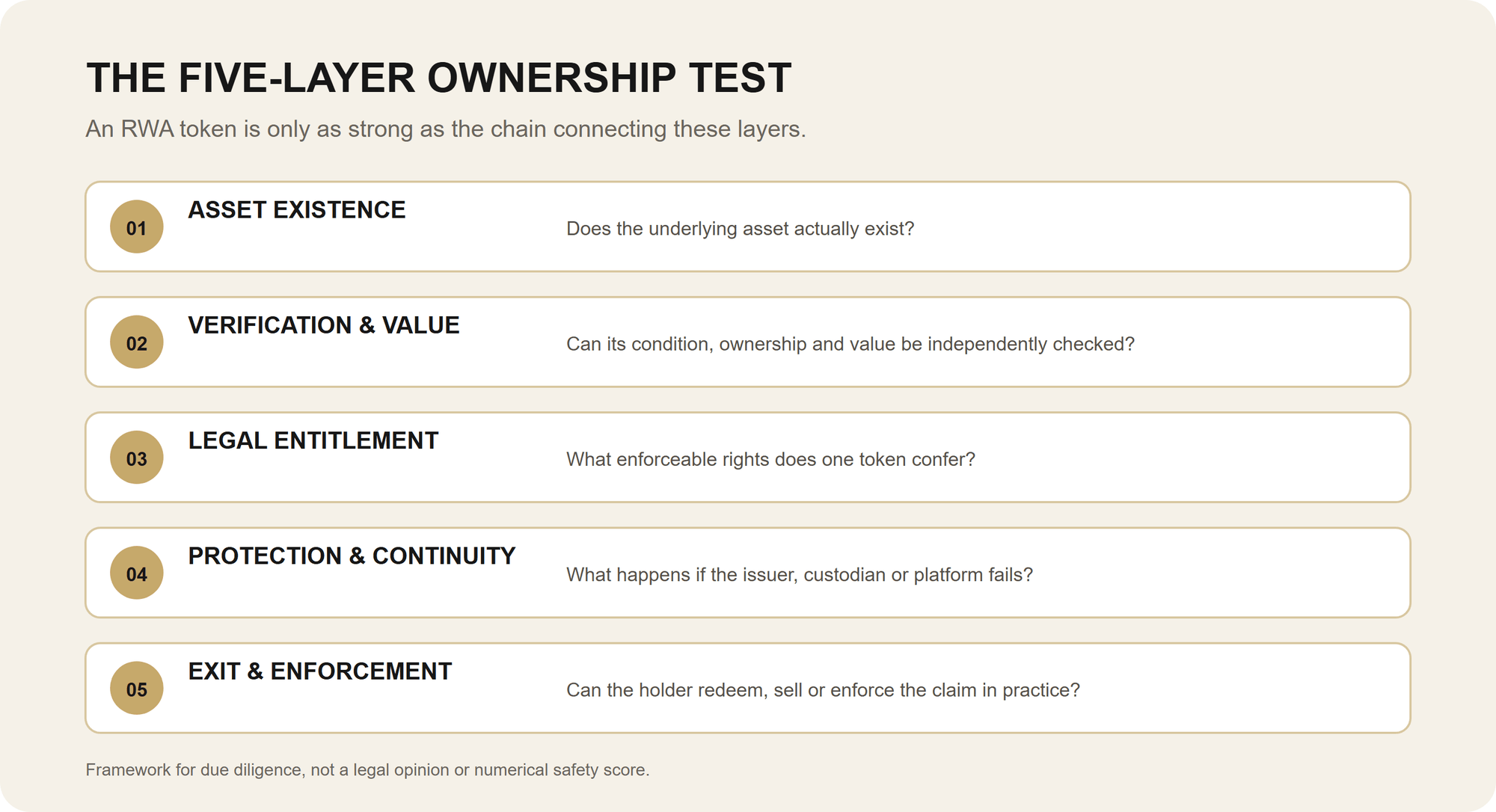
5. Five layers of RWA due diligence: the Five-Layer Ownership Test
I propose evaluating RWA offerings through five separate layers. A project should not be considered robust merely because it performs well on one layer.
 (opens in a new tab)
Layer 1: Asset existence
Does the underlying asset exist? For a property, this could involve title documents, a land-registry search, a site inspection and confirmation of the legal owner. For commodities, it may require warehouse receipts, inventory controls and independent verification. For financial assets, it may involve custodian statements, issuer records and independent reconciliation.
Failure mode: The token exists, but the claimed asset is missing, misdescribed, duplicated or materially different from what was advertised.
Layer 2: Asset verification and valuation
Can the asset's existence, quantity, condition, encumbrances and value be checked independently? How frequently is it verified? Who appoints the verifier? Does the verifier inspect the asset itself or only review documents supplied by the issuer?
Failure mode: The asset exists, but the valuation is stale, assumptions are optimistic, liabilities are undisclosed or the verification process is not independent enough.
Layer 3: Legal entitlement
What precisely does one token confer? Direct ownership, a share, a fund unit, a beneficial interest, a secured debt, an unsecured contractual claim or price exposure? Which law governs the right? Which event legally completes a transfer?
Failure mode: The token can be transferred technically, but the holder cannot establish the advertised ownership or enforce the promised rights.
Layer 4: Asset protection and continuity
Are assets segregated? Who holds them? What happens if the issuer, custodian, trustee, registrar, platform or key technology provider fails? Are there replacement arrangements, recoverable records and tested business-continuity procedures?
Failure mode: The asset remains valuable, but the investor cannot access it, exercise rights or obtain records during a dispute or service-provider failure.
Layer 5: Exit and enforcement
Can holders redeem or sell the token under defined conditions? Who must buy or redeem it? Are there gates, lockups, notice periods, transfer restrictions or minimum redemption sizes? If a dispute arises, where and how can a holder enforce the claim?
Failure mode: The token trades on a screen, but the holder cannot convert it into cash or enforce a claim at a reasonable time and cost.
Why five layers matter
A project can pass asset existence and valuation checks but fail legal entitlement. It can have sound legal rights but weak custody controls. It can have good custody and legal structure but no realistic exit market.
The five layers are not a numerical score and do not replace professional due diligence. They are a way to prevent one impressive feature—usually a blockchain dashboard, audit, valuation or regulatory logo—from being mistaken for proof of overall safety.
 (opens in a new tab)
6. Fractional ownership can widen access, but it does not create liquidity
Tokenization can divide economic interests into smaller units and automate parts of transfer and settlement. These are potentially meaningful benefits. The IMF (opens in a new tab) and IOSCO (opens in a new tab) both recognise the potential for efficiency and broader access while cautioning that adoption remains limited or constrained and that risks remain.
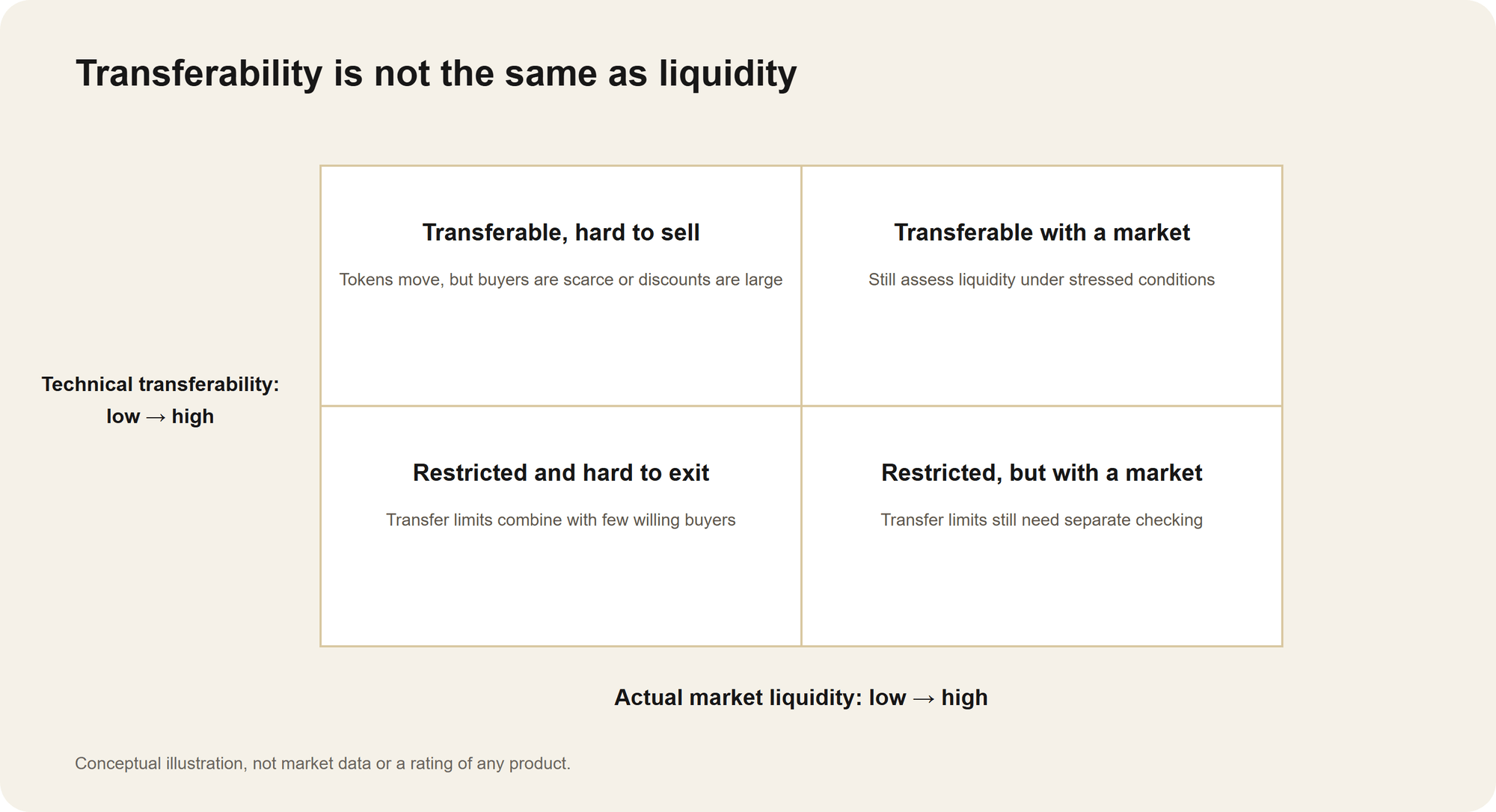
But fractionalisation and liquidity are different things.
A building worth RM10 million does not become easier to sell simply because its economic exposure is divided into 10 million tokens. A secondary market still needs willing buyers and sellers, reliable price discovery, legally valid transfers, adequate disclosure, settlement assets, market access and rules for stressed conditions.
A token may be technically transferable at any time while being practically illiquid. It may trade at a discount to the stated asset value. A platform may suspend trading. Redemption may be limited by the underlying asset's sale process. A buyer may be unable to transfer the token to a wallet or venue that recognises it.
The Monetary Authority of Singapore's October 2026 remarks (opens in a new tab) noted that meaningful commercial adoption has often occurred within smaller ecosystems and that a platform's ability to tokenise an asset does not automatically give it access to wider market liquidity. It also emphasised the need for common approaches to servicing, disclosure, interoperability and risk management.
My view: “24/7 tradable” should be treated as a statement about technical availability, not a guarantee of continuous liquidity or fair exit value.
7. Smart contracts automate rules. They do not eliminate legal disputes.
Smart contracts can automate distributions, transfer restrictions, compliance checks, settlement conditions and corporate actions. Properly designed, tested and governed, they can reduce manual work and reconciliation.
However, code can only enforce the rules that have been encoded and the events that the system can reliably observe. Many real-world events—damage to a building, a court injunction, a disputed invoice, a change in beneficial ownership or a contested valuation—require trusted external information and human or legal processes.
This creates an oracle and governance problem: who is authorised to provide the external fact, correct an error, pause a contract or resolve a conflict? What happens if the code's behaviour conflicts with the governing legal documents?
A credible offering should explain:
- who can upgrade, pause or administer the smart contract;
- whether privileged keys are held by one party or governed by multiple parties;
- how security audits are scoped and what they do not guarantee;
- how mistaken transfers, stolen keys and court orders are handled;
- how on-chain and off-chain records are reconciled; and
- which document prevails if the token interface, smart contract and legal contract conflict.
An audit of code is evidence about the code reviewed. It is not a legal opinion on asset ownership, proof that the underlying asset exists, or a guarantee that the project will remain solvent.
8. Cross-border tokenization: which law decides?
An RWA token can involve an issuer incorporated in one country, an asset located in another, investors across multiple countries, a custodian in a fourth jurisdiction and a blockchain whose validators are geographically dispersed.
That arrangement can raise questions about governing law, property rights, security interests, insolvency, investor eligibility, securities regulation, data, tax and enforcement. The applicable answers do not automatically follow the blockchain's location or the location of the investor's wallet.
Legal reform is moving, but it is jurisdiction-specific. In England and Wales, the Property (Digital Assets etc) Act 2025 received Royal Assent on 2 December 2025. It clarifies that an asset is not excluded from being an object of personal property rights merely because it does not fit within the traditional categories. The Law Commission (opens in a new tab) also stresses that courts will continue to develop the boundaries of this category. This is a development concerning digital assets as property; it does not mean every token confers ownership of an off-chain asset.
In Malaysia, the SC's published FAQ (opens in a new tab) distinguishes tokenised capital market products from digital currencies and digital tokens and says existing requirements for the relevant capital market product continue to matter. In April 2026, Khazanah Nasional and the SC announced Malaysia's first tokenised sukuk (opens in a new tab), with a nominal value of RM100 million. The pilot is evidence of a real institutional use case, not proof that every RWA token or tokenisation model has the same legal status or investor protections.
Investors should not infer regulatory approval from a project's use of blockchain, its overseas incorporation, its association with a well-known institution, or the existence of a pilot elsewhere. The relevant product, issuer, distribution activity and investor rights must be assessed in the relevant jurisdiction.
9. An investor's checklist: eight questions before buying
Before purchasing an RWA token, ask the issuer for clear, document-backed answers to these questions:
- What exactly do I own? Ask for the legal rights attached to one token, not just a marketing description.
- Who legally owns the underlying asset? Identify the registered owner and any SPV, trust, fund, custodian or nominee in the chain.
- What document connects my token to that asset? Request the governing agreement, trust deed, security document, shareholder register or other relevant instrument.
- What happens if the issuer becomes insolvent? Ask whether the claim is proprietary, secured, unsecured, subordinated or otherwise limited.
- Is the asset encumbered or segregated? Look for independent verification of liens, mortgages, competing claims and asset segregation.
- Who verifies existence and value? Check independence, scope, frequency, methodology, date and limitations.
- How do I exit? Distinguish secondary-market trading from issuer redemption and from the eventual sale of the underlying asset.
- Who regulates the actual activity, and how are disputes resolved? Verify the relevant entity and permissions with the appropriate regulator; identify governing law, forum and enforcement path.
If an issuer cannot explain these matters in plain language, treat that as a due-diligence warning. A sophisticated interface is not a substitute for intelligible legal rights.
10. What a trustworthy RWA infrastructure should look like
A mature RWA product should connect its on-chain and off-chain components through a clearly documented legal and operational design.
At minimum, that design should include:
- Rights-first product design: Define the investor's legal rights before deciding how to represent them on-chain.
- Authoritative records: Identify which ledger, register, title record or legal document is authoritative for each relevant right.
- Independent verification: Verify the underlying asset, ownership, valuation and encumbrances using appropriate independent methods.
- Asset segregation and insolvency planning: Explain how assets are held, who has claims against them and how the structure behaves if a service provider fails.
- Transparent lifecycle governance: Document issuance, transfer, distributions, freezes, corrections, upgrades, redemptions and dispute handling.
- Credible exit arrangements: Disclose liquidity limits, redemption terms, market-making arrangements and what happens during stress.
- Regulatory and jurisdictional clarity: Explain the legal entities involved, their roles, relevant permissions and the markets in which the product may lawfully be offered.
- Security and operational resilience: Test smart contracts, protect privileged keys, reconcile records and maintain incident-response and recovery procedures.
These are not claims that every project must use the same technical architecture. The right design depends on the asset class, legal structure, investors and applicable law. The objective is alignment: the token's behaviour, the legal documents and the real-world asset records should tell a consistent story.
11. The real innovation is not putting an asset on a blockchain
The strongest case for tokenization is not that everything should become a token. It is that programmable records may help coordinate ownership records, compliance, transfer restrictions, payment, settlement and servicing in a more integrated way.
The IMF's October 2026 analysis (opens in a new tab) frames tokenization as a potential redesign of market infrastructure while highlighting constraints around legal certainty, regulation, interoperability and settlement. The FSB (opens in a new tab) has also identified potential vulnerabilities involving liquidity and maturity mismatch, leverage, asset price and quality, interconnectedness and operational fragility if tokenization scales without adequate safeguards.
The challenge is therefore institutional as much as technological. A tokenized market still needs reliable asset data, enforceable claims, sound governance, trusted settlement, dispute resolution and a clear allocation of responsibility.
The market should stop treating the word “tokenized” as a quality label. Tokenization describes a method of representing or managing rights. It does not automatically tell us whether those rights are valuable, enforceable, protected or liquid.
My conclusion
The most important question about an RWA token is not, “Which blockchain is it on?”
It is:
“If the issuer, platform or custodian disappeared tomorrow, what enforceable right would remain, and how could I exercise it?”
If the answer is clear, documented and supported by a workable legal structure, blockchain may improve the way that right is recorded, transferred or serviced. If the answer is unclear, the token may simply digitise an existing uncertainty.
The next phase of tokenization should be measured not by how many assets can be turned into tokens, but by how reliably investors can understand, verify and enforce the rights those tokens represent.
A token can make ownership easier to transfer. Only a sound legal and operational structure can make the ownership claim worth trusting.
What do you think should be the minimum standard for an RWA token: independent proof of the asset, enforceable legal rights, insolvency protection, or all three?
Sources and Further Reading
International Monetary Fund, "Scaling Tokenization: New Efficiencies, New Vulnerabilities", Global Financial Stability Report, Chapter 3, October 2026. Constraints on tokenized markets, including legal certainty, and what the legal framework needs to establish. Read the chapter (opens in a new tab).
Bank for International Settlements, "The tokenisation continuum", BIS Bulletin No. 72, 11 April 2023. The core layer and service layer of tokenisation. Read the bulletin (opens in a new tab).
Securities Commission Malaysia, "Frequently Asked Questions on Tokenised Capital Market Products". How token rights affect legal characterisation, and the risks intermediaries must address. Read the FAQ (opens in a new tab).
International Swaps and Derivatives Association (ISDA), ISDA Quarterly, Vol. 12, Issue 1, April 2026. Includes "A Legal Perspective" (pages 32–33) on defining ownership and issuer insolvency. Read the issue (opens in a new tab).
International Organization of Securities Commissions (IOSCO), "Tokenization of Financial Assets: Final Report", November 2025. Adoption, potential efficiency gains and remaining risks. Read the report (opens in a new tab).
Monetary Authority of Singapore, "Building Trusted Foundations for Digital Finance", speech by Managing Director Chia Der Jiun, 9 October 2026. Adoption within smaller ecosystems, access to liquidity and common approaches. Read the speech (opens in a new tab).
Law Commission of England and Wales, "The Property (Digital Assets etc) Act 2025 has received Royal Assent", 3 December 2025. What the Act clarifies, and what it leaves to the courts. Read the announcement (opens in a new tab).
Securities Commission Malaysia, "Khazanah Leads Malaysia's First Tokenised Sukuk Pilot in Collaboration with the SC", 28 April 2026. The RM100 million pilot. Read the release (opens in a new tab).
Financial Stability Board, "The Financial Stability Implications of Tokenisation", 22 October 2024. Potential vulnerabilities if tokenisation scales. Read the report (opens in a new tab).
Editorial note
This article is educational analysis, not legal, investment, tax or financial advice. The legal status of a token depends on its terms, structure, governing law and the facts of the offering. Research checked 1 November 2026. Laws, guidance and product documents may change.