Executive summary
The resolution of Paraguay’s Ueno Bank is a useful case study for anyone building or investing in financial infrastructure. It is not evidence that traditional banking is inherently unsafe, nor proof that crypto infrastructure is safer. It shows something more fundamental: technology, distribution and customer growth cannot compensate for weak balance-sheet discipline, opaque related-party exposures, poor governance or ineffective oversight.
The Central Bank of Paraguay (BCP) said (opens in a new tab) it began Ueno’s resolution process after adjustments to the bank’s financial statements during a regularisation process left its solvency ratio below 50% of the regulatory minimum. The regulator described the action as a case-specific intervention, intended to protect depositors and preserve financial stability. FIX SCR (opens in a new tab) downgraded Ueno to Dpy on 3 November, citing undisclosed related-party operations, asset-quality weaknesses and documentation deficiencies.
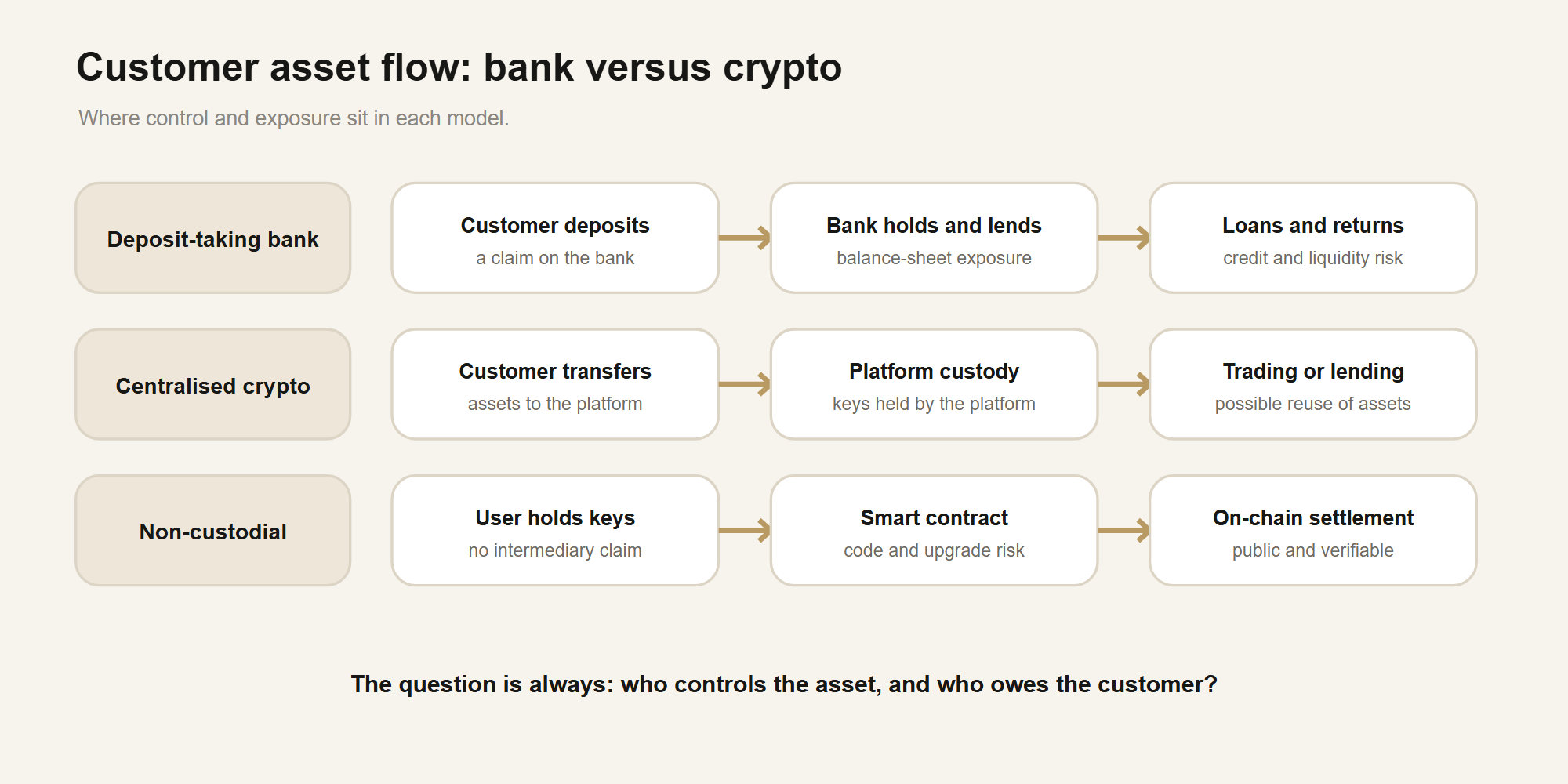
The crypto comparison is therefore not “banks versus blockchain”. It is a comparison between different ways of holding, moving, lending and safeguarding value. A well-designed crypto platform can offer visible on-chain movements, cryptographic controls and stronger customer-asset segregation. But a centralised exchange or crypto intermediary that rehypothecates customer assets, lends against them, runs maturity mismatches or hides liabilities can recreate familiar banking risks, sometimes without equivalent deposit insurance or lender-of-last-resort support.
The central lesson: infrastructure is only as trustworthy as its governance, balance sheet, controls, legal structure and ability to prove what it owes.
Latest developments as at 8 November 2026
The Ueno case has moved beyond bank resolution. Paraguay's Chamber of Deputies approved an impeachment accusation against President Santiago Peña on 5 November, and the Senate removed him from office on the night of 6 November. On 7 November, the Associated Press reported (opens in a new tab) that prosecutors had charged him with breach of trust and administration for personal gain, and that a judge ordered him held in pretrial detention at a military facility. Reuters reported (opens in a new tab) the same day that his lawyer said he pleads not guilty, and that the judge also ordered former central bank governor Carlos Carvallo into pretrial detention on related charges. Peña denies wrongdoing.
These are charges and procedural steps, not findings of guilt. Legal responsibility is for the courts to decide.
Reuters also reported on 7 November that the central bank said the equivalent of about US$160 million had been paid to nearly 1.2 million savers under the deposit guarantee. That measures payment progress. It does not show that every depositor has been repaid in full, or that balances above the guaranteed limit have been recovered.
The bank-resolution facts and the political and criminal proceedings should be read separately. The proceedings raise questions about supervisory independence, related-party controls and the governance of public-sector deposits, but they do not change what the regulator has stated about the bank.
1. What happened at Ueno Bank?
Ueno grew rapidly into a prominent Paraguayan bank. Reuters reported (opens in a new tab) that it had about three million customers and held roughly US$850 million in public funds. Al Jazeera (opens in a new tab), citing central bank data, put the public funds at about US$800 million, including about US$380 million from Paraguay’s state pension and health fund. These are reported figures, not a complete audited statement of the bank’s liabilities or losses.
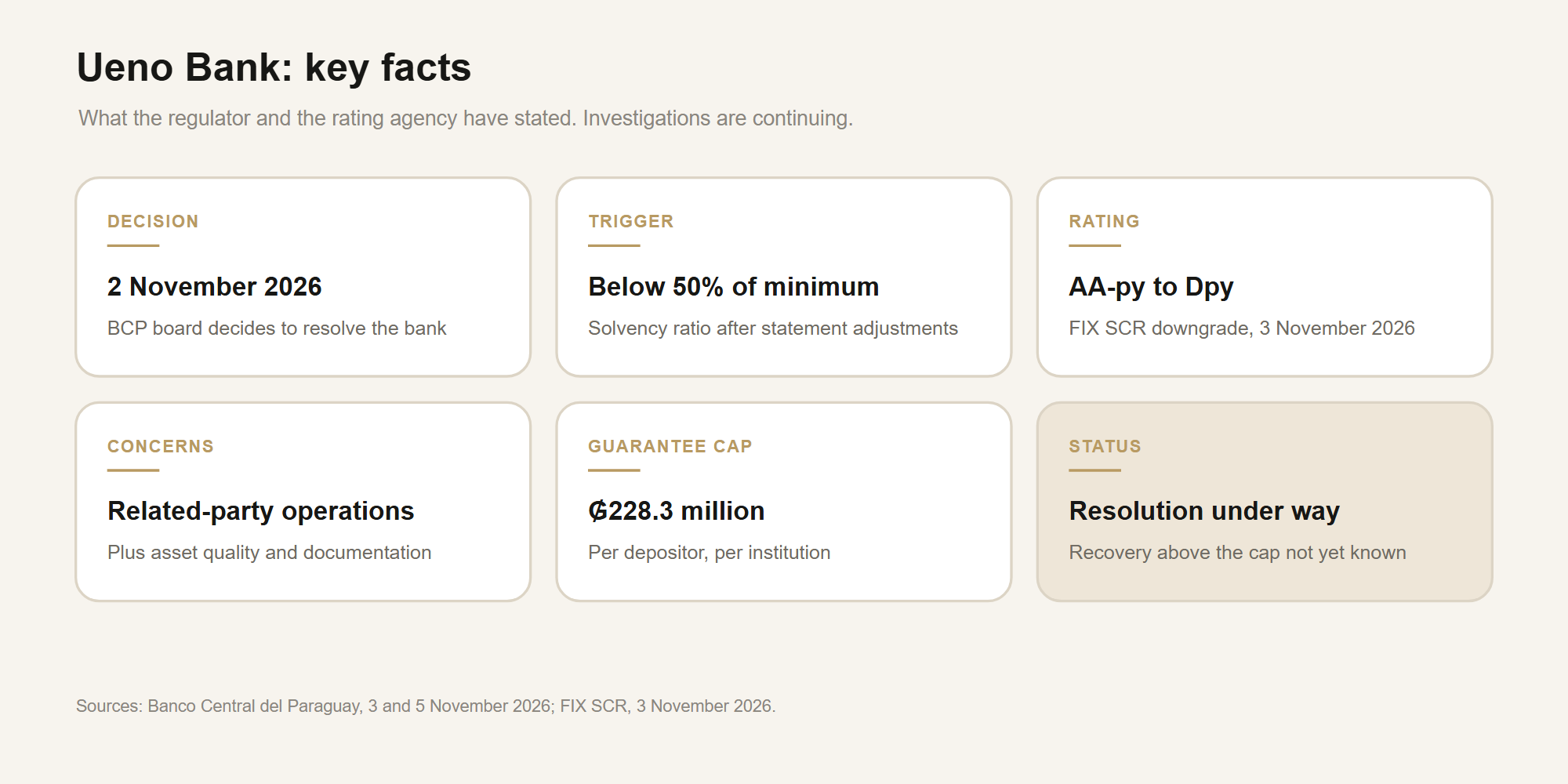
On 2 November 2026, the BCP’s board unanimously decided to begin a formal resolution process. Its public statement (opens in a new tab), dated 3 November, said that adjustments made to Ueno’s financial statements during the regularisation process had left its solvency ratio below half of the minimum required. The BCP said the procedure was being conducted under Paraguay’s deposit-guarantee and financial-institution-resolution law (Law 2.334/03). It described the case as specific to Ueno, not a general condition of the Paraguayan financial system.
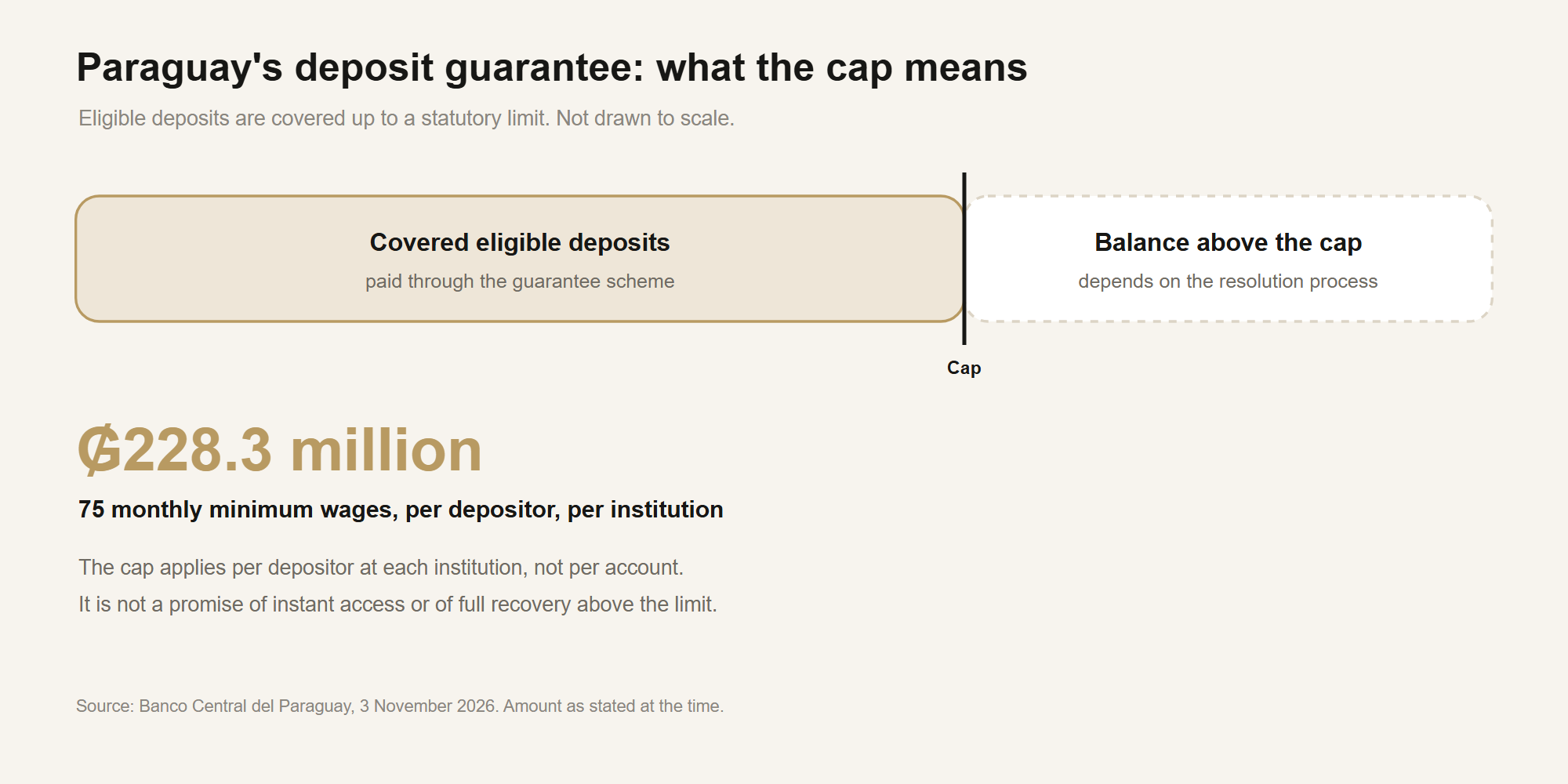
The BCP stated that eligible deposits are protected up to 75 monthly minimum wages, then equivalent to ₲228.3 million per depositor per institution. That is a statutory cap, not a promise that every depositor can immediately withdraw every balance. On 5 November, the BCP announced an initial payment group (opens in a new tab) for depositors with balances up to ₲10 million, no debt to the bank and an account at another local financial institution.
 View the image full size
FIX SCR’s 3 November rating action (opens in a new tab) downgraded Ueno from AA-py to Dpy. It cited operations with related companies that had not been disclosed, weaknesses in asset quality, deficiencies in transaction documentation and lending to related companies above the permitted limits. FIX said this information emerged from the central bank’s resolution process, and that some of it had not been provided to the rating agency by the bank.
Media reporting has described scrutiny of lending to companies linked to Ueno’s controlling shareholder, Grupo Vázquez, and questions about public-fund exposure and regulatory independence. Those are serious governance questions, but allegations and investigations should not be treated as final findings of criminal liability. Reuters reported (opens in a new tab) that former President Santiago Peña had previously held a stake in Grupo Vázquez, which he said he sold in March 2025; he denied wrongdoing. The political consequences developed rapidly after the bank intervention. This article does not infer guilt from political association or an ongoing investigation.
What the case does—and does not—establish
It establishes that the regulator found a solvency shortfall severe enough to trigger resolution, following adjustments to financial statements. It also establishes that the rating agency cited undisclosed related-party operations, asset-quality weaknesses and documentation problems.
It does not, by itself, establish that every customer deposit is lost, that the entire Paraguayan banking system is insolvent, or that digital banking technology caused the failure. The BCP expressly characterised the case as institution-specific. The eventual recovery for balances above the guarantee limit, the final asset shortfall and the outcome of investigations remain matters for the resolution and legal processes.
 View the image full size
2. The risk comparison: Ueno-style bank versus crypto infrastructure
“Crypto infrastructure” is not one business model. It may mean a non-custodial wallet, a custody provider, an exchange, a stablecoin issuer, a broker, a DeFi protocol, a tokenisation platform or a company combining several of these activities. Their risks differ substantially.
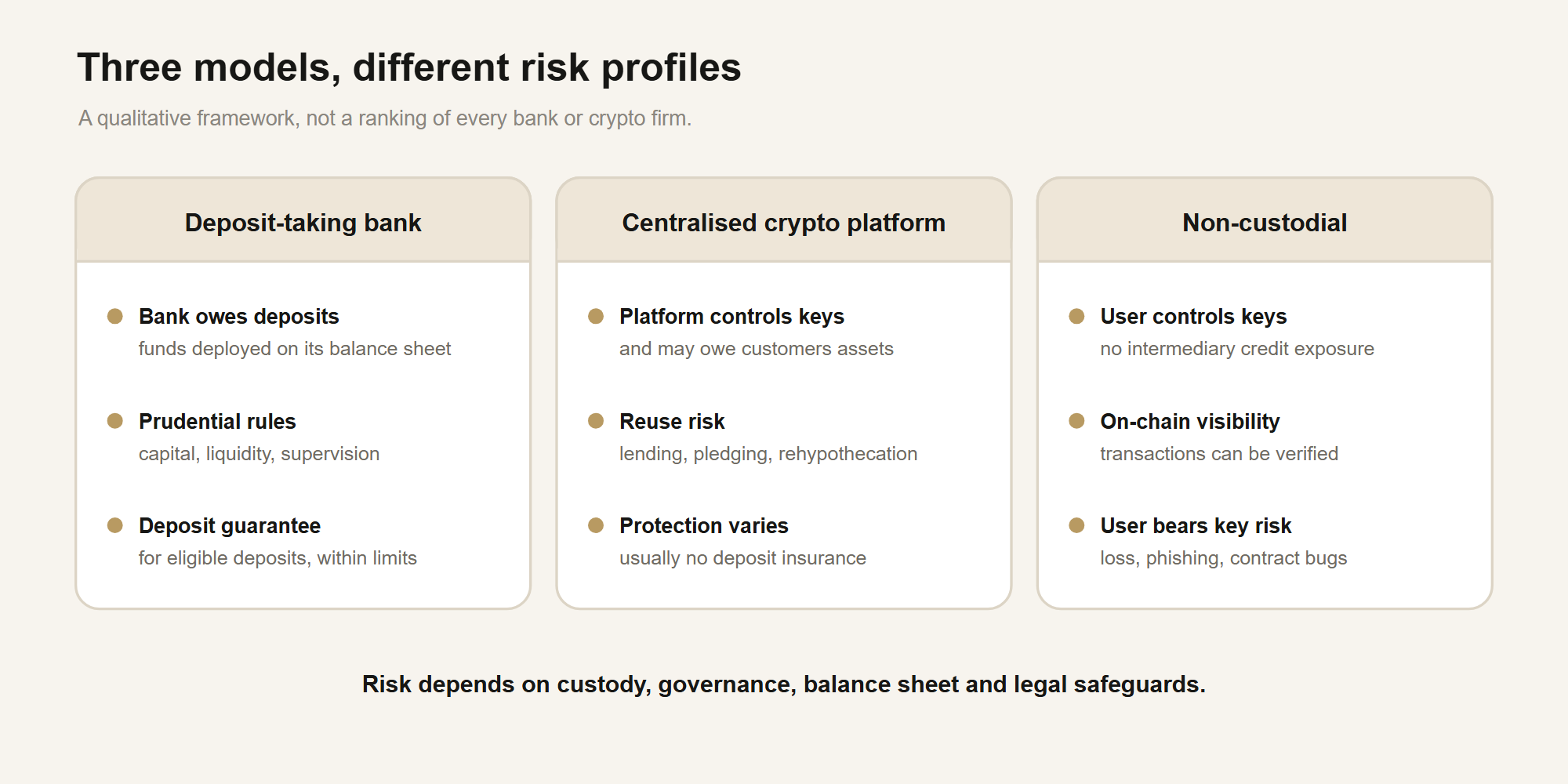
| Risk dimension | Deposit-taking bank (Ueno-type model) | Centralised crypto exchange / intermediary | Non-custodial / on-chain infrastructure |
|---|---|---|---|
| Customer asset control | Bank owes deposits; funds are deployed through its balance sheet | Platform may control keys and may owe customers assets or cash | User generally controls keys; protocol rules govern on-chain execution |
| Lending and reuse | Lending is core to banking and is constrained by prudential rules | Customer assets may be lent, pledged or reused depending on product terms | No platform lending by default, but DeFi protocols can create lending exposure |
| Transparency | Audited statements, regulatory returns and supervisory access; public visibility can still lag | Proof-of-reserves can show selected assets, but not necessarily all liabilities or off-chain claims | Public chains expose transactions, but identities, off-chain liabilities and beneficial ownership may remain opaque |
| Liquidity | Deposit withdrawals can exceed immediately available cash; central-bank facilities may exist subject to rules | Runs can occur if users demand withdrawals faster than assets can be liquidated | On-chain liquidity is visible but can disappear, fragment or become expensive during stress |
| Capital / loss absorption | Capital adequacy rules and supervisory intervention apply | Prudential rules vary by jurisdiction and activity; often not equivalent to banks | Protocols have no corporate capital buffer unless specifically designed with one |
| Custody failure | Bank insolvency and resolution law determine depositor treatment | Key compromise, internal fraud, commingling or insolvency can impair recovery | Self-custody removes intermediary credit exposure but shifts key-management and operational risk to the user |
| Consumer protection | Deposit guarantee may apply to eligible deposits, within limits | Usually no bank-style deposit insurance for cryptoassets | Typically no deposit insurance; recovery depends on law, protocol design and user key control |
| Governance | Board, management, audit, related-party rules and supervisor | Corporate controls, token governance and conflicts of interest vary widely | Code governance, upgrade keys, multisigs, validators and admin privileges matter |
This table is a framework, not a verdict on every bank or crypto company. A licensed bank with strong controls may be safer for ordinary deposits than an opaque exchange. A properly designed non-custodial wallet may reduce intermediary insolvency exposure, but it cannot make volatile assets stable or protect a user who loses their private keys.
 View the image full size
 View the image full size
3. Where the risks are actually similar
Related-party lending and hidden concentration
Ueno’s case highlights why exposures to shareholders, executives, affiliates and connected borrowers need strict limits, independent approval, disclosure and monitoring. The same principle applies to crypto businesses.
An exchange may lend customer assets to an affiliated market maker, use them as collateral, route liquidity to a related trading desk or concentrate exposure in a small number of counterparties. The technical architecture may be modern, but the economic risk is familiar: a connected party can create losses that are difficult for customers to see.
Control: disclose related-party exposures; impose board-approved limits; require independent credit review; prohibit undisclosed reuse of customer assets; publish concentration and collateral policies.
Solvency is not the same as liquidity
A business can own assets worth more than its liabilities and still fail if those assets cannot be sold or transferred quickly enough. Conversely, a platform may appear liquid during normal markets while carrying hidden losses or contingent liabilities.
Banks manage liquidity through asset-liability management, capital and liquidity rules, and—in eligible circumstances—central-bank facilities. Crypto intermediaries may face 24/7 withdrawals, volatile collateral, exchange fragmentation, blockchain congestion and no equivalent central-bank backstop.
Control: daily liquidity monitoring, stress tests, maturity ladders, concentration limits, clear withdrawal terms and pre-agreed emergency procedures.
Proof of reserves is not a full audit
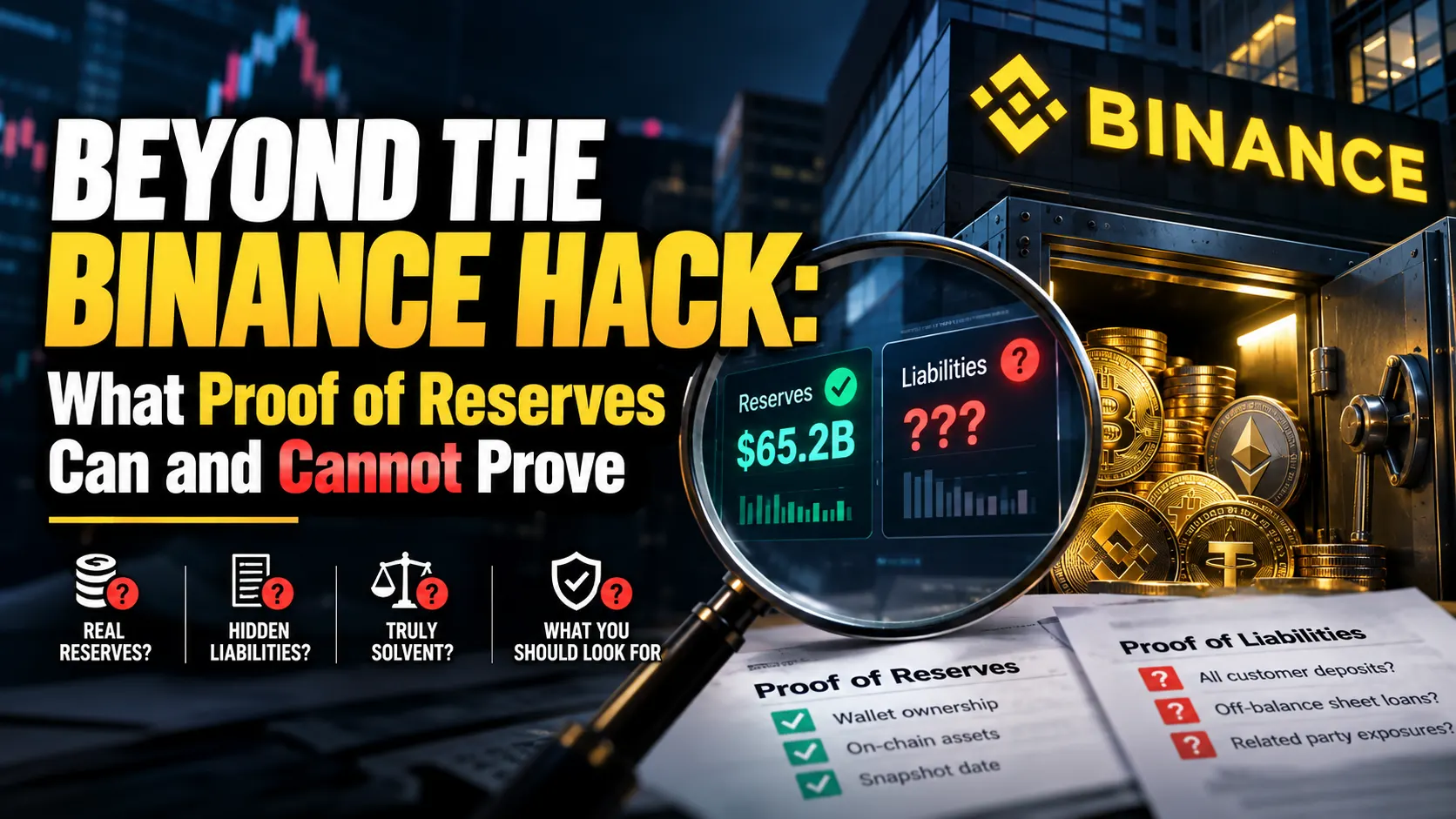
Proof of Reserves (PoR) can help demonstrate that a custodian controls certain on-chain assets at a point in time. But it is not automatically proof that all customer liabilities are included, that assets are unencumbered, that off-chain debts are disclosed, or that the business is solvent.
A meaningful assurance programme should combine:
- Proof of assets and wallet control.
- Complete, independently verified customer liabilities.
- Disclosure of pledged, borrowed or encumbered assets.
- Legal confirmation of customer ownership and segregation.
- Financial-statement audit and internal-control assurance.
- Reconciliation at a defined frequency, with exceptions disclosed.
The same broader principle applies to banks: a single capital ratio or snapshot does not replace a full view of asset quality, connected exposures, liquidity and governance.
4. Where crypto infrastructure can be structurally different
Non-custodial design can reduce intermediary credit risk
In a genuine non-custodial wallet, the user controls the private keys and the provider cannot unilaterally move the assets. This can reduce exposure to a provider’s insolvency or misuse of pooled customer funds.
However, non-custodial does not mean risk-free. Users face phishing, malware, seed-phrase loss, compromised devices, malicious approvals, smart-contract bugs and irreversible transaction errors. A provider can also introduce centralised dependencies through recovery services, relayers, bridges or upgrade controls.
On-chain transparency improves observability, not necessarily accountability
Public blockchains can make transactions and wallet balances independently observable. This is a meaningful advantage over opaque internal ledgers. But an address is not automatically a known legal entity, and on-chain data does not reveal every loan, guarantee, legal claim or off-chain obligation.
Transparency becomes useful when wallet ownership, liabilities, encumbrances, governance rights and audit scope are clearly mapped and independently verified.
MPC and multi-signature controls improve key governance
Multi-party computation (MPC) and multi-signature schemes can distribute signing authority and reduce single-person control. They can support separation of duties, transaction policy enforcement and auditable approvals.
They do not solve poor governance by themselves. If all signers are controlled by the same executives, if recovery procedures are weak, or if privileged administrators can change policy without independent oversight, the control may be mostly cosmetic.
5. What the BIS and regulators are warning about
The Bank for International Settlements’ Financial Stability Institute published an April 2026 paper (opens in a new tab) examining cryptoasset service providers that perform bank-like intermediation. It notes that yield or earn products, lending, market-making, derivatives and token issuance can create credit, liquidity and maturity risks. When customer assets are transferred to an intermediary for use in these activities, the economic relationship can resemble deposit-taking or prime brokerage, but prudential safeguards may be weaker or inconsistent across jurisdictions.
FINMA’s January 2026 guidance (opens in a new tab) on cryptoasset custody also stresses that customer assets should not become part of a custodian’s bankruptcy estate and that legal arrangements, supervision and cross-border custody structures matter. The point is important: cryptography can prove control of a key, but insolvency law determines who owns the asset and how it is recovered.
These regulatory perspectives support a neutral conclusion. Crypto infrastructure is not inherently safer than banking. It can be more transparent and more modular, but only if its legal, operational and financial design matches the risks of the activities it performs.
6. A practical control framework for exchanges, custodians and Web3 platforms
A robust crypto infrastructure operator should be able to answer the following questions clearly.
Customer assets
- Are customer assets legally and operationally segregated?
- Are assets held in wallets that can be independently identified?
- Are customer assets prohibited from being lent, pledged or rehypothecated without explicit, informed consent?
- Can the business demonstrate complete liabilities as well as assets?
Balance sheet and liquidity
- Does the company publish audited financial statements?
- Are related-party loans, guarantees and exposures disclosed?
- Are liquidity and solvency stress tests performed?
- Are assets encumbered, borrowed or subject to liens?
Technology and operations
- Are signing keys protected by MPC or multi-signature controls?
- Are approval thresholds and withdrawal policies enforced technically?
- Are smart contracts independently audited and continuously monitored?
- Are incident response, disaster recovery and key-rotation procedures tested?
Governance and compliance
- Are directors and executives subject to fit-and-proper review?
- Are conflicts of interest declared and independently managed?
- Are AML, sanctions screening, transaction monitoring and suspicious-activity escalation effective?
- Are custody, exchange, lending, staking and issuance activities appropriately licensed in each jurisdiction?
7. Malaysia and Southeast Asia: why this matters
For Malaysia and the wider Southeast Asian market, the lesson is not to choose banks over crypto or crypto over banks. It is to evaluate the exact legal entity, licence, activity and custody model.
A crypto exchange, digital-asset custodian, tokenisation platform and payment provider may face different regulatory requirements. A licence for one activity should not be presented as approval for every other activity. Cross-border structures also create questions about which entity owes the customer, where assets are held, which law governs insolvency and which regulator can intervene.
For businesses building in this region, the practical priority should be:
- Map each product to its actual regulated activity.
- Identify the contracting entity and the entity holding customer assets.
- Keep customer assets separate from operating funds.
- Establish independent governance for related-party dealings.
- Maintain auditable reserves, liabilities and financial statements.
- Design for orderly wind-down, customer transfers and complaint handling.
8. Neutral verdict: which model is safer?
There is no universal winner. The answer depends on the product and the quality of implementation.
- For everyday fiat deposits: a well-capitalised, well-supervised bank with credible deposit protection is generally designed to provide protections that a crypto exchange does not.
- For direct control of digital assets: a properly implemented non-custodial wallet can reduce dependence on a single intermediary, but places more security responsibility on the user.
- For exchange trading and yield products: a centralised crypto intermediary can recreate bank-like credit and liquidity risks while potentially offering weaker deposit-style protections.
- For transparency: public-chain data can provide stronger transaction visibility, but it does not replace complete liability disclosure, legal segregation or independent audit.
- For systemic resilience: banks have established prudential frameworks and resolution tools, although Ueno illustrates that these controls can fail or be applied too late. Crypto firms vary widely, and regulatory coverage remains uneven.
Ueno should therefore be understood primarily as a case study in governance, connected lending, asset quality, disclosure and supervisory risk—not as a referendum on digital banking technology. The crypto industry should not use the case to claim superiority. It should use it as a warning against repeating the same economic mistakes behind a different interface.
Conclusion: trust is an operating system, not a marketing claim
The future of financial infrastructure will likely combine banks, payment networks, stablecoins, tokenised assets, custodians and public blockchains. The winning models will not be those with the most fashionable technology. They will be the ones that can demonstrate, continuously and independently, what they hold, what they owe, who controls the assets, how conflicts are managed and what happens when the business fails.
The most important question is not whether the institution is a bank or a crypto company. It is whether customers can verify the safeguards before a crisis—not after one.
Frequently asked questions
Did Ueno Bank collapse because it was a digital bank? The available regulator and rating-agency explanations focus on solvency, related-party exposures, asset quality and documentation. They do not establish that digital banking technology caused the failure.
Were all Ueno deposits protected? No. Paraguay’s statutory deposit-guarantee cap was ₲228.3 million per depositor per institution at the time of the BCP announcement, subject to legal eligibility. Recovery of balances above the cap depends on the resolution process and creditor-priority rules.
Does Proof of Reserves prevent a crypto exchange collapse? No. Proof of Reserves may show control of selected on-chain assets at a point in time, but it may not reveal all liabilities, encumbrances, off-chain obligations, related-party exposures or legal claims. It is not a substitute for a full audit and governance controls.
Is self-custody safer than keeping assets on an exchange? Self-custody can remove the exchange’s insolvency and rehypothecation risk for those assets, but it transfers responsibility for private-key security, backups, transaction signing and recovery to the user. Smart-contract and network risks may still apply.
What should a business check before choosing a bank or crypto provider? Review legal claims, licensing, financial condition, customer-asset segregation, related-party exposures, independent audits, liquidity arrangements, incident response, redemption terms and the provider’s resolution or recovery process.
Sources and Further Reading
Banco Central del Paraguay, "Banco Central inicia el procedimiento de resolución de ueno bank", 3 November 2026. The board's unanimous decision of 2 November, the solvency ratio below 50% of the regulatory minimum after adjustments to the financial statements, the legal basis and the deposit guarantee of 75 monthly minimum wages (₲228.3 million) per depositor, per institution. In Spanish. Read the statement (opens in a new tab).
Banco Central del Paraguay, "Comunicado sobre inicio de pagos de garantía a los depositantes de ueno bank SA", 5 November 2026. The first payment group: deposits up to ₲10 million, no debt to the bank and an account at another local institution. In Spanish. Read the statement (opens in a new tab).
FIX SCR, "FIX baja la calificación a Dpy de UENO Bank S.A.", 3 November 2026. The downgrade from AA-py to Dpy and its reasons: undisclosed operations with related companies, asset quality, documentation and lending above related-party limits. In Spanish. Read the rating action (opens in a new tab).
Reuters, "What is ueno bank and how did it trigger Paraguay's political crisis?", 5 November 2026. About three million customers, roughly US$850 million in public funds, scrutiny of lending to companies linked to Grupo Vázquez, and Santiago Peña's former stake and denial. Read the article (syndicated copy) (opens in a new tab).
Al Jazeera, "How Paraguay's Ueno collapse is only its latest banking crisis", 6 November 2026. About US$800 million in public funds, including about US$380 million from the state pension and health fund, citing central bank data. Read the article (opens in a new tab).
Reuters, "Judge orders Paraguay's ex-president Peña held before trial", 7 November 2026. The pretrial detention order, the charges, the not-guilty plea, the detention order for Carlos Carvallo and the central bank's figure of about US$160 million paid to nearly 1.2 million savers. Read the article (syndicated copy) (opens in a new tab).
Associated Press, "Paraguay's ousted president charged with crimes linked to collapse of major bank", 7 November 2026. The Senate's removal of Santiago Peña, the charges of breach of trust and administration for personal gain, and the pretrial detention order. Read the article (PBS NewsHour) (opens in a new tab).
Bank for International Settlements, Financial Stability Institute, "Cryptoasset service providers as financial intermediaries: risks and policy approaches", FSI Occasional Paper 27, 23 April 2026. How yield, lending, market-making, derivatives and token issuance create credit, liquidity and maturity risks at crypto intermediaries. Read the paper (opens in a new tab).
FINMA, "FINMA publishes guidance on risks associated with the custody of cryptobased assets", Guidance 01/2026, 12 January 2026. Keeping customer assets out of a custodian's bankruptcy estate, and the risks of custody abroad. Read the guidance (opens in a new tab).
Board of Governors of the Federal Reserve System, FDIC and OCC, "Agencies issue joint statement on risk-management considerations for crypto-asset safekeeping", 14 July 2025. Risk management for banks that hold crypto-assets for customers. Read the statement (opens in a new tab).
Editorial note
This article is an independent educational analysis, not legal, investment, banking or financial advice. It is not a ranking of banks or crypto companies, and the risk comparison is qualitative.
This is a developing story. The criminal proceedings are at an early stage: charges and detention orders are not findings of guilt, and everyone named is presumed innocent until a court decides otherwise. Figures such as customer numbers and public-fund exposure are reported figures, not audited statements, and the payment figure describes progress at the time it was reported. Recovery of balances above the deposit-guarantee cap depends on the resolution process.
Reuters and Associated Press reports are linked through syndicated copies where the original could not be checked. Sources last checked on 8 November 2026.