Executive summary
On 10 November 2026, Binance announced (opens in a new tab) that it would stop processing transactions involving MEXC and a list of named related entities. Transfers sent from Binance to those entities would be declined. Deposits received from them would be temporarily withheld for compliance review, and affected users could face account restrictions or offboarding under Binance’s terms. The policy followed a 6 November action (opens in a new tab) by the US Financial Crimes Enforcement Network (FinCEN), which identified MEXC Global as a foreign financial institution of primary money-laundering concern in connection with Russian illicit finance.
The headline is not simply that one exchange has blocked another. It is that a regulatory action directed at a foreign platform can influence the behaviour of global intermediaries well beyond the direct legal reach of the original order. Binance has made its own operational decision, while other firms may reassess their exposure to the same counterparties.
Three distinctions matter. First, FinCEN’s order is not a blanket global ban on MEXC, and its prohibition is directed at covered US financial institutions. Second, the order was published in the Federal Register (opens in a new tab) on 10 November 2026 and takes effect on 10 December 2026. Third, Binance’s own restrictions, announced the same day, are a separate platform decision with their own scope and consequences. These are related measures, but they are not the same legal instrument.
The broader lesson is that crypto’s public blockchains may be open networks, but the routes between exchanges, banks, stablecoin issuers and fiat payment systems are controlled by institutions. Users can hold private keys and still depend on intermediaries when they need liquidity, conversion, custody, or access to the banking system.
A blockchain transfer can be borderless. Access to the exchange that receives it is not.
1. What happened: a regulatory action, followed by a platform decision
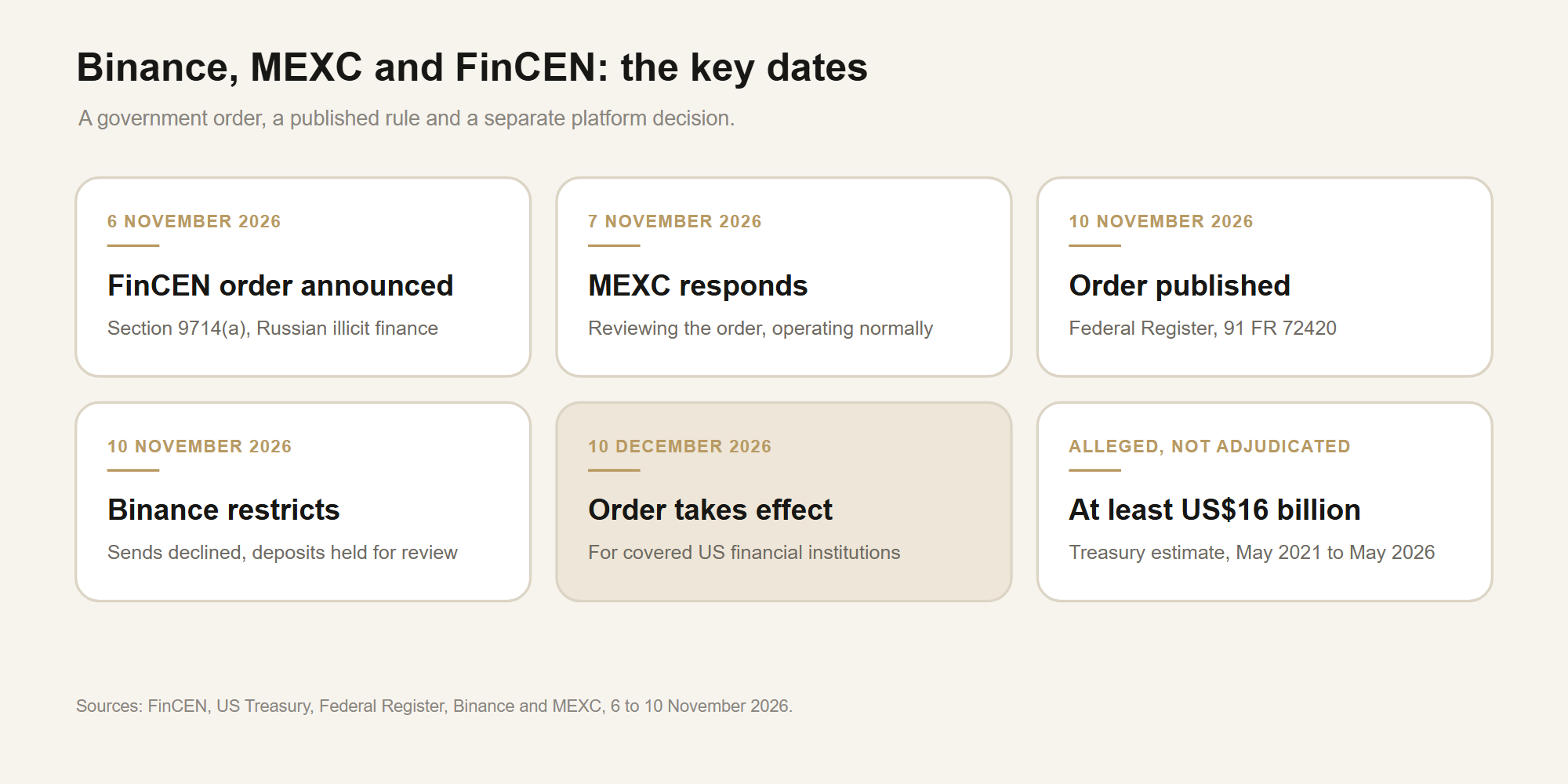
The sequence moved quickly:
| Date | Development | Why it matters |
|---|---|---|
| 6 November 2026 | FinCEN announced an order concerning MEXC Global under section 9714(a) of the Combating Russian Money Laundering Act. | The US action identified MEXC Global as a foreign financial institution of primary money-laundering concern in connection with Russian illicit finance. |
| 7 November 2026 | MEXC published a response saying it was reviewing the order with its legal and compliance teams, that the platform was operating normally and that it had begun an independent review of its AML and sanctions controls. | The exchange disputed neither the existence of the order nor the need to review it, but its public statement did not provide a detailed point-by-point response to the underlying allegations. |
| 10 November 2026 | Binance published restrictions covering MEXC and named related entities. | Binance said outgoing transfers to the entities would be declined and incoming deposits would be temporarily withheld for compliance review. |
| 10 November 2026 | FinCEN’s order was published in the Federal Register (91 FR 72420). | The order takes effect on 10 December 2026, 30 days after publication. |
Sources: FinCEN announcement (opens in a new tab), MEXC statement (opens in a new tab), Binance announcement (opens in a new tab), Federal Register (opens in a new tab).
 View the image full size
The Binance notice lists MEXC Global Limited, MEXC Estonia OÜ, GIDA Technology AG, MXC Global Ltd, MEXC Global Foundation Ltd, MEXC Singapore Pte Ltd, MEXC (Comoros) Ltd, MEXC, MEXC Global, MEX Global Ltd, MX Global LTD, the former name MEX Exchange, and MEXC affiliates. It tells users not to send to, receive from, or otherwise transact through Binance involving those entities, directly or indirectly.
That wording is broader than a simple address block. It is a counterparty-risk instruction: Binance is warning that it may treat an incoming transfer associated with the listed entities as a compliance event, even if the customer believes the transfer is routine.
2. The legal action behind the exchange restriction
FinCEN is a bureau of the US Department of the Treasury responsible for safeguarding the financial system from illicit use, including through anti-money-laundering rules and financial intelligence. In this case it invoked section 9714(a) of the Combating Russian Money Laundering Act, as amended, to prohibit certain fund transmittals involving MEXC Global by covered financial institutions.
The order describes MEXC Global, including subsidiaries, branches, offices and successor entities operating outside the United States, as a foreign financial institution of primary money-laundering concern in connection with Russian illicit finance. It prohibits certain transmittals of funds involving MEXC Global by covered financial institutions. It was published in the Federal Register (opens in a new tab) on 10 November 2026 and takes effect on 10 December 2026, 30 days after publication.
What does the US government allege?
The Treasury Department says (opens in a new tab) that between May 2021 and May 2026, MEXC Global facilitated at least US$16 billion in transactions connected to sanctions evasion, cybercrime and other illicit activity. The department also cites nearly US$1.5 billion in transactions linked to Russian sanctions evasion, including US$232 million in direct transactions with entities sanctioned by the United States, European Union and United Kingdom. It says MEXC continued processing transactions with Garantex and its successor Grinex as recently as June 2026.
Treasury further alleges approximately US$1 billion in direct transactions with more than 40 identified Iranian crypto exchangers, and approximately US$22 million in transactions benefiting Iran’s sanctioned central bank and the Islamic Revolutionary Guard Corps and its Qods Force.
These figures must be read carefully. The US$16 billion figure is the government’s estimate of funds connected to illicit activity over a five-year period. It should not be casually restated as US$16 billion of customer assets stolen, US$16 billion proven to be criminal proceeds, or US$16 billion currently held by MEXC. The public announcement is a government enforcement position, not a final judicial finding after a trial.
The distinction between a designation and a global shutdown
The order is a powerful measure, but its legal scope matters. It directs covered US financial institutions not to process specified transfers involving MEXC Global. It does not, by itself, order every bank, exchange or wallet provider in every country to close MEXC accounts. Nor does it automatically convert every MEXC-related wallet address into an asset-freezing designation under the separate OFAC sanctions programme. Treasury expressly notes that the order does not modify existing Bank Secrecy Act or OFAC obligations.
Yet the commercial effect can travel further than the legal boundary. A global exchange may decide that processing a particular counterparty creates unacceptable regulatory, banking, reputational or operational risk. That is the space in which Binance’s decision sits.
3. What Binance’s notice actually means
Binance’s 10 November notice sets out two principal outcomes:
| Transfer direction | Binance’s stated treatment |
|---|---|
| Binance account to a listed MEXC entity | The request will be declined. |
| Listed MEXC entity to Binance | The deposit will be temporarily withheld and referred for compliance review. |
| Account associated with the activity | Restrictions may be applied during review; further action may include offboarding under Binance’s Terms of Use. |
This is not the same as saying every customer who has ever used MEXC will automatically lose access to Binance. The notice says deposits from the listed entities will be held for review and that impacted accounts may face restrictions. The exact outcome will depend on the transaction, the relevant entity, the account history, the evidence available and Binance’s applicable terms. Binance has not published a universal review timetable in the notice.
The reference to direct and indirect transactions is particularly important. In crypto, a customer may withdraw from one exchange to a self-custody wallet, move assets through another address, use a broker or payment intermediary, and later deposit to a third exchange. Blockchain analytics can sometimes identify exposure through transaction paths, but attribution is probabilistic and depends on data quality, clustering methods and the platform’s risk policies. A wallet address is not always equivalent to a legally identified person or corporate entity.
Users should therefore avoid assuming that changing the route or using an intermediary will make a transaction acceptable. Attempting to disguise the origin of funds can create additional compliance concerns. The appropriate response to a legitimate transfer problem is to contact the receiving platform, disclose the transaction path and provide supporting records.
4. Why a centralised exchange can become a gatekeeper
A centralised exchange is more than a trading interface. It typically combines several functions:
- Custody: it controls private keys for assets held in exchange accounts.
- Market access: it matches buyers and sellers and provides order-book liquidity.
- Conversion: it may connect crypto balances to fiat currencies or stablecoins.
- Settlement: it manages internal ledger transfers and external blockchain withdrawals.
- Compliance: it screens customers, counterparties, wallet exposure and transaction patterns.
- Banking access: it depends on banks, payment providers, stablecoin issuers and correspondent relationships.
The result is a layered system. A blockchain may allow a token to move from address A to address B, but a centralised exchange can decide whether it will credit the deposit, permit trading, or allow conversion into fiat. The blockchain’s consensus rules do not compel a private exchange to accept a customer or a deposit.
The gatekeeper effect
- A user controls an asset or holds a balance at Exchange A.
- The user attempts to move it to Exchange B.
- Exchange B screens the sending address, entity attribution, transaction history and other risk indicators.
- Exchange B may credit the deposit, delay it, reject it, or restrict the account pending review.
- If the asset is held in a custodial account, the customer’s practical access depends on the platform’s procedures and applicable law.
This is why self-custody and exchange custody should not be treated as interchangeable. Self-custody gives the holder direct control of private keys, but does not guarantee that a regulated or risk-sensitive intermediary will accept funds later. Conversely, an exchange balance may be convenient, but it is a contractual claim against a platform rather than direct control of the underlying blockchain keys.
5. Borderless networks, jurisdictional chokepoints
Crypto is often described as borderless because public blockchains can validate transactions without a bank or national clearing house. That description is technically true but economically incomplete.
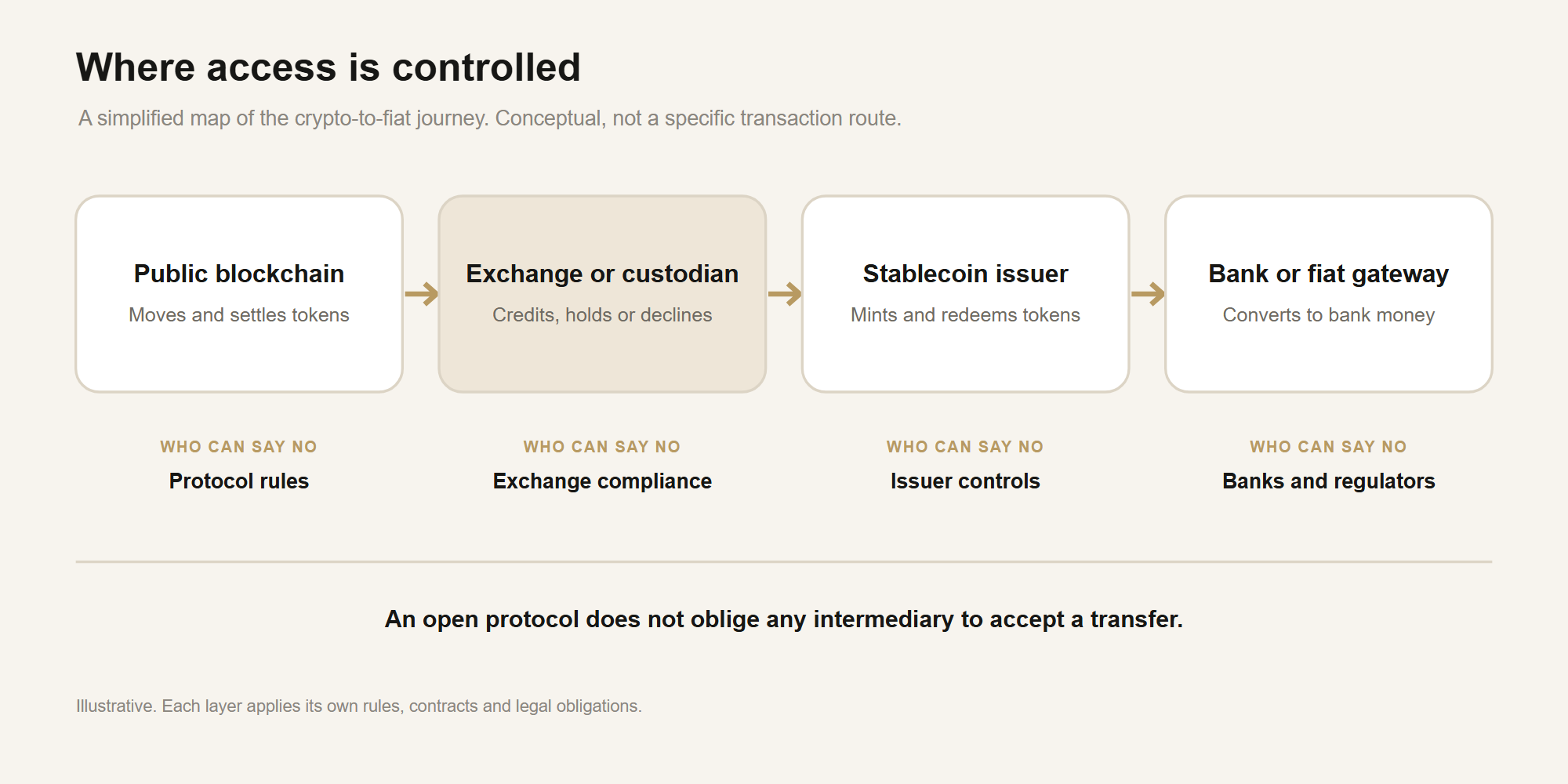
The full user journey often includes several non-blockchain dependencies:
| Layer | What it enables | Who may control access |
|---|---|---|
| Public blockchain | Transfer and settlement of on-chain tokens | Protocol rules, validators, miners or sequencers |
| Centralised exchange | Trading, custody and internal transfers | Exchange operator and its compliance policies |
| Stablecoin | Dollar-linked settlement and liquidity | Issuer, reserve banks and contract controls |
| Fiat on/off-ramp | Conversion between bank money and crypto | Banks, payment firms and licensed intermediaries |
| Banking and correspondent network | Access to domestic and international payments | Banks and regulators in relevant jurisdictions |
A user can move a non-custodial token without asking Binance for permission. But if the user’s desired destination is a Binance account, Binance controls whether it will accept and credit the deposit. If the user wants to redeem a stablecoin for bank money, the issuer and banking partners may introduce another gate.
The practical lesson is not that decentralised networks have failed. It is that decentralised settlement and centralised access coexist. A blockchain can be permissionless at the protocol layer while the surrounding financial services remain permissioned.
 View the image full size
6. The user-level risks
The most immediate risk is not necessarily permanent loss. It is uncertainty: a transfer may be delayed, rejected or subjected to additional documentation requirements at the moment the user needs liquidity.
Funds temporarily unavailable
Binance says incoming deposits from listed entities will be temporarily withheld for compliance review. A temporary hold can still have real economic consequences if the customer needs the funds to meet margin requirements, settle an obligation, or respond to market volatility. The notice does not specify a standard review duration.
Account-level restrictions
The announcement says Binance may restrict impacted accounts during review and may take further action, including offboarding. A user should not assume that the review will be limited to the value of one deposit.
Liquidity fragmentation
When exchanges stop accepting transfers from one another, capital becomes less portable. Traders may face additional steps, fees, price slippage and operational delays. Arbitrage becomes harder when assets cannot move freely between venues. These frictions can weaken price alignment, particularly during periods of market stress.
False positives and attribution disputes
Blockchain analytics can associate addresses with entities, but the strength of attribution varies. Shared custody infrastructure, omnibus wallets, payment processors and intermediary services can complicate the picture. A customer may have a legitimate economic relationship with a platform without having direct dealings with the entity named in a notice. That does not guarantee an exemption, but it makes transparent records and a clear review process important.
Counterparty concentration
Users who keep most of their trading capital on one exchange may face a different risk from users who spread operational exposure across custodians and self-custody. Diversification does not eliminate risk, and it can add complexity, but it reduces dependence on a single platform’s withdrawal, listing, compliance and operational decisions.
7. The case for stronger controls, and the case against overreach
There is a legitimate public-interest case for strict financial controls. Exchanges that facilitate transfers for sanctioned actors, cybercriminal networks or other illicit organisations can undermine sanctions policy and expose the wider financial system to abuse. Platforms that operate internationally and connect to fiat rails cannot credibly treat compliance as someone else’s problem.
FinCEN’s action is framed around alleged weaknesses in MEXC’s anti-money-laundering and sanctions controls. Treasury says the platform’s controls failed to prevent transactions involving prohibited jurisdictions and sanctioned actors. MEXC, in its 7 November statement (opens in a new tab), said it was reviewing the order, operating normally and beginning an independent review of its AML and sanctions controls. That is the publicly available response identified for this article; it should not be mistaken for a full evidentiary rebuttal.
But broad restrictions also create risks:
- Due process: customers need understandable reasons, a channel to submit evidence and a way to challenge mistaken attribution.
- Proportionality: restrictions should be calibrated to the relevant entity, activity and risk rather than applied indiscriminately.
- Transparency: platforms should explain what is blocked, what is held, what documentation is required and what review stages exist.
- Consistency: similarly situated users should not receive arbitrary outcomes.
- Operational resilience: exchanges should maintain processes for legitimate customers whose funds are caught in a counterparty review.
The right question is not whether exchanges should comply with the law. They must. The question is how to apply controls accurately, proportionately and with meaningful recourse for legitimate users.
8. What exchanges, institutions and users should do
For exchanges and custodians
- Maintain a current legal-entity and counterparty register, not merely a list of brand names.
- Map subsidiaries, historical names, successor entities and wallet infrastructure.
- Separate sanctions screening from broader risk scoring, and document the basis for each decision.
- Provide clear deposit-hold notices, evidence requirements, escalation channels and review timelines where legally possible.
- Test whether a policy can identify indirect exposure without treating every multi-hop transaction as conclusive proof of wrongdoing.
- Maintain liquidity and operational contingency plans for sudden counterparty restrictions.
For institutional clients
- Review treasury flows and settlement dependencies across exchanges, OTC desks, custodians and stablecoin issuers.
- Identify single points of failure in deposit and withdrawal routes.
- Keep transaction records, invoices, source-of-funds documents and wallet ownership evidence.
- Confirm counterparties and permitted routes with compliance teams before moving material balances.
- Avoid relying on a single venue for critical settlement or liquidity.
For individual users
- Read the latest official notices from both the sending and receiving platforms before transferring.
- Do not attempt to evade screening by routing funds through intermediaries or concealing the origin of assets.
- Keep transaction hashes, withdrawal confirmations, account statements and records showing the source and purpose of funds.
- If a deposit is held, contact the receiving platform through official support channels and provide the requested evidence.
- Do not share seed phrases or private keys with anyone claiming to be support.
- Consider whether long-term holdings should remain in self-custody, while understanding that self-custody brings its own security and recovery responsibilities.
This is general operational information, not legal or investment advice. Users facing a specific freeze or legal notice should seek qualified advice in the relevant jurisdiction.
9. What to watch next
The next developments will determine whether this remains a targeted counterparty restriction or becomes a broader market-access event.
- The effective date: the FinCEN order was published on 10 November and takes effect on 10 December 2026. Until then, watch for any further guidance from FinCEN.
- MEXC’s substantive response: whether the exchange publishes detailed evidence, remediation steps or outcomes from its independent compliance review.
- Other intermediaries: whether additional exchanges, banks, stablecoin issuers or payment providers adopt restrictions involving the named entities.
- Customer treatment: whether platforms publish clearer review timelines, evidence standards and appeal mechanisms.
- Regulatory follow-through: whether further actions, clarifications or court proceedings emerge.
A key indicator will be whether restrictions remain focused on the legal entities named in the order or expand to a wider set of wallets and counterparties through private risk policies. Those are not equivalent developments and should be reported separately.
10. Conclusion: the real power lies at the interfaces
The Binance–MEXC episode exposes a structural truth about digital finance. The blockchain may be open, but the institutions that connect tokens to trading, custody, stablecoins and bank money retain considerable discretion over access.
That discretion is not inherently illegitimate. It is part of the infrastructure required to prevent illicit finance and protect regulated financial channels. But as exchanges become critical gateways, their decisions can affect users who are not accused of wrongdoing and whose transactions may be legitimate.
The future of crypto will therefore be shaped not only by faster blockchains or new tokens, but by the quality of the interfaces between decentralised networks and regulated institutions. The strongest ecosystem will not be one without controls. It will be one where controls are evidence-based, transparent, proportionate and accompanied by credible processes for legitimate users.
Crypto may be borderless at the protocol layer. The question is whether its users can still move value predictably across the institutions that stand between them and the wider financial system.
Frequently asked questions
Has Binance banned MEXC completely? Binance announced that it will not process transactions involving the MEXC entities and affiliates listed in its notice. It will decline transfers from Binance accounts to those entities and temporarily withhold deposits received from them for compliance review. This is a transaction restriction on Binance, not a statement that MEXC has ceased operating globally.
Does FinCEN’s action apply to every exchange worldwide? The order prohibits specified fund transmittals involving MEXC Global by covered US financial institutions. Other exchanges outside the United States may make their own legal and risk decisions. Binance’s action is a separate platform policy.
Does the US$16 billion figure mean MEXC stole US$16 billion? No. Treasury describes at least US$16 billion in transactions connected to illicit activity over May 2021 to May 2026. That is not the same as saying the funds were all stolen, all proven criminal proceeds, or all customer assets lost. It is the government’s stated estimate and allegation.
Will funds sent from MEXC to Binance be lost? Binance says deposits from listed entities will be temporarily withheld for compliance review. It does not say that every such deposit will be permanently confiscated. The outcome and timing depend on the review and applicable terms. Users should contact Binance through official support and retain transaction records.
Can users avoid the restriction by using a personal wallet? A self-custody wallet gives the user control of private keys, but it does not guarantee that a centralised exchange will accept a later deposit. Binance’s notice refers to direct and indirect transactions. Trying to disguise a transaction path can create additional risk; users should disclose the facts and seek a compliant route rather than attempting to circumvent screening.
Is crypto still decentralised? Public blockchain networks can be decentralised at the protocol level. Exchanges, custodians, stablecoin issuers and fiat gateways are separate institutions with their own controls. Decentralised settlement does not mean universal access to centralised financial services.
What should a user do if a deposit is held? Use the platform’s official support channel, request the reason and evidence requirements, and provide transaction hashes, account statements and source-of-funds records. Never disclose a seed phrase or private key.
Sources and Further Reading
Financial Crimes Enforcement Network, "Operation Economic Outcast Severs MEXC Global's Access to the U.S. Financial System", 6 November 2026. FinCEN's announcement of the order, describing MEXC Global as a convertible virtual currency exchanger that facilitated at least US$16 billion in illicit transactions. Read the announcement (opens in a new tab).
Financial Crimes Enforcement Network, "Imposition of Special Measure Prohibiting the Transmittal of Funds Involving MEXC Global", Federal Register, 91 FR 72420, 10 November 2026. The order under section 9714(a) of the Combating Russian Money Laundering Act, its scope (MEXC Global and its subsidiaries, branches, offices and successors outside the United States) and its effective date of 10 December 2026. Read the order (opens in a new tab).
US Department of the Treasury, "Operation Economic Outcast Severs MEXC Global's Access to the U.S. Financial System", 6 November 2026. The allegations: at least US$16 billion in illicit transactions from May 2021 to May 2026, nearly US$1.5 billion linked to Russian sanctions evasion, about US$1 billion with Iranian exchangers, and the statement that the order does not change Bank Secrecy Act or OFAC obligations. Read the press release (opens in a new tab).
Binance, "Important: Transactions with Certain Crypto Platforms", 10 November 2026. The listed MEXC entities, declined transfers to them, deposits from them withheld for compliance review, and possible account restrictions or offboarding. Read the announcement (opens in a new tab).
MEXC, "Statement Regarding FinCEN's November 6 Order", 7 November 2026. MEXC's response: reviewing the order, operating normally and beginning an independent review of its AML and sanctions controls. Read the statement (opens in a new tab).
Editorial note
This article is for information and general education. It is not legal, regulatory, financial or investment advice, and it does not determine whether any particular person, wallet or transaction is lawful.
The US$16 billion figure and the other amounts are the US government's allegations and estimates, not findings of a court. MEXC has not been convicted of any offence. The article distinguishes government allegations, published regulatory instruments, platform announcements and the author's analysis. Readers should consult the relevant authorities and qualified professionals before making decisions about specific transactions or legal obligations.
Sources last checked on 11 November 2026, including the Federal Register publication of the FinCEN order.