Executive summary
For years, blockchain was framed as a challenge to traditional banking. The emerging institutional reality is more complicated. Banks, central banks and payment networks are now testing whether the technology can modernise the machinery of regulated finance itself.
Three developments make this shift concrete. First, the Bank for International Settlements' Project Agorá (opens in a new tab) has moved beyond a paper concept: its prototype combined tokenised commercial-bank deposits with tokenised central-bank reserves, and its July 2026 real-value testing involved 28 financial institutions and central banks, 17 transaction scenarios and approximately CHF 800,000 in transactions. The BIS reported an average time from payment initiation to settlement of about 80 seconds in that controlled test. Second, SWIFT announced (opens in a new tab) in July 2026 that its blockchain-based ledger was ready for initial use, with 17 banks preparing to pilot tokenised-deposit transactions. Third, Malaysia, Singapore and Thailand have joined forces through the BLOOM initiative (opens in a new tab) to develop common approaches for cross-border digital money, while Malaysia is separately testing ringgit stablecoins and tokenised deposits.
These are not proof that blockchain has replaced banking. They are evidence that regulated institutions are exploring a different operating model: money represented digitally, shared transaction state, programmable conditions and settlement that may be coordinated across institutions and borders.
The central question is therefore changing. It is no longer simply whether crypto can disrupt banks. It is whether banks can use tokenisation to make existing financial obligations move more efficiently, and whether the legal, operational and governance foundations can keep pace.
Key takeaways
- Tokenised deposits remain claims on commercial banks. A new technical format does not turn them into central-bank money.
- Wholesale central-bank money can provide the settlement asset in experimental architectures such as Project Agorá.
- Stablecoins, tokenised deposits and central-bank digital currencies have different issuers, legal claims and risk profiles.
- Interoperability, legal finality, liquidity, privacy, compliance and recovery arrangements matter as much as transaction speed.
- Southeast Asia is becoming a meaningful policy and experimentation region, with BNM, MAS and the Bank of Thailand involved in BLOOM.
- The likely outcome is a hybrid system, not the disappearance of banks, SWIFT or national payment systems.
1. The quiet shift: blockchain is moving inside regulated finance
The first generation of blockchain narratives often presented a binary choice: decentralised networks on one side, banks and established payment systems on the other. That framing misses the institutional direction now taking shape.
A bank deposit is already digital in the sense that most balances exist as records in banking systems rather than as physical notes. Tokenisation changes how that claim is represented, transferred and coordinated. A tokenised deposit is generally a digital representation of a deposit liability issued by a commercial bank. It remains a claim on that bank and remains subject to the legal and prudential framework governing the deposit.
That distinction is fundamental. Putting a deposit on a distributed ledger does not automatically make it risk-free, universally accessible or equivalent to central-bank reserves. What it may change is the way payment instructions, conditions, asset transfers and settlement records are coordinated.
The institutional appeal is practical. Today's cross-border payments can involve multiple banks, messaging systems, correspondent relationships, compliance checks, operating windows and reconciliation processes. Each institution may maintain its own record of the transaction. Tokenised infrastructure seeks to reduce some of these hand-offs by synchronising relevant records and embedding transaction conditions into a shared workflow.
The opportunity is not simply a faster transfer. It is a more coordinated transaction.
2. Project Agorá: a prototype for a different kind of cross-border payment
Project Agorá is a public-private collaboration led by the BIS Innovation Hub, with the private-sector participants convened by the Institute of International Finance. It brings together eight central banks and more than 40 private financial institutions. Its purpose is to explore whether tokenisation and programmability can improve wholesale cross-border payments while preserving the role of central-bank money and regulated commercial banks.
The prototype combines two forms of money:
- Tokenised commercial-bank deposits, which remain liabilities of participating commercial banks.
- Tokenised central-bank reserves, which represent central-bank money used by eligible financial institutions for settlement.
The design aims to allow these forms of money to interact on a shared programmable platform. Smart-contract logic can coordinate conditions, payment instructions and the exchange of assets. In principle, this can support atomic settlement: either all linked legs of a transaction complete, or none do.
What did the 2026 testing show?
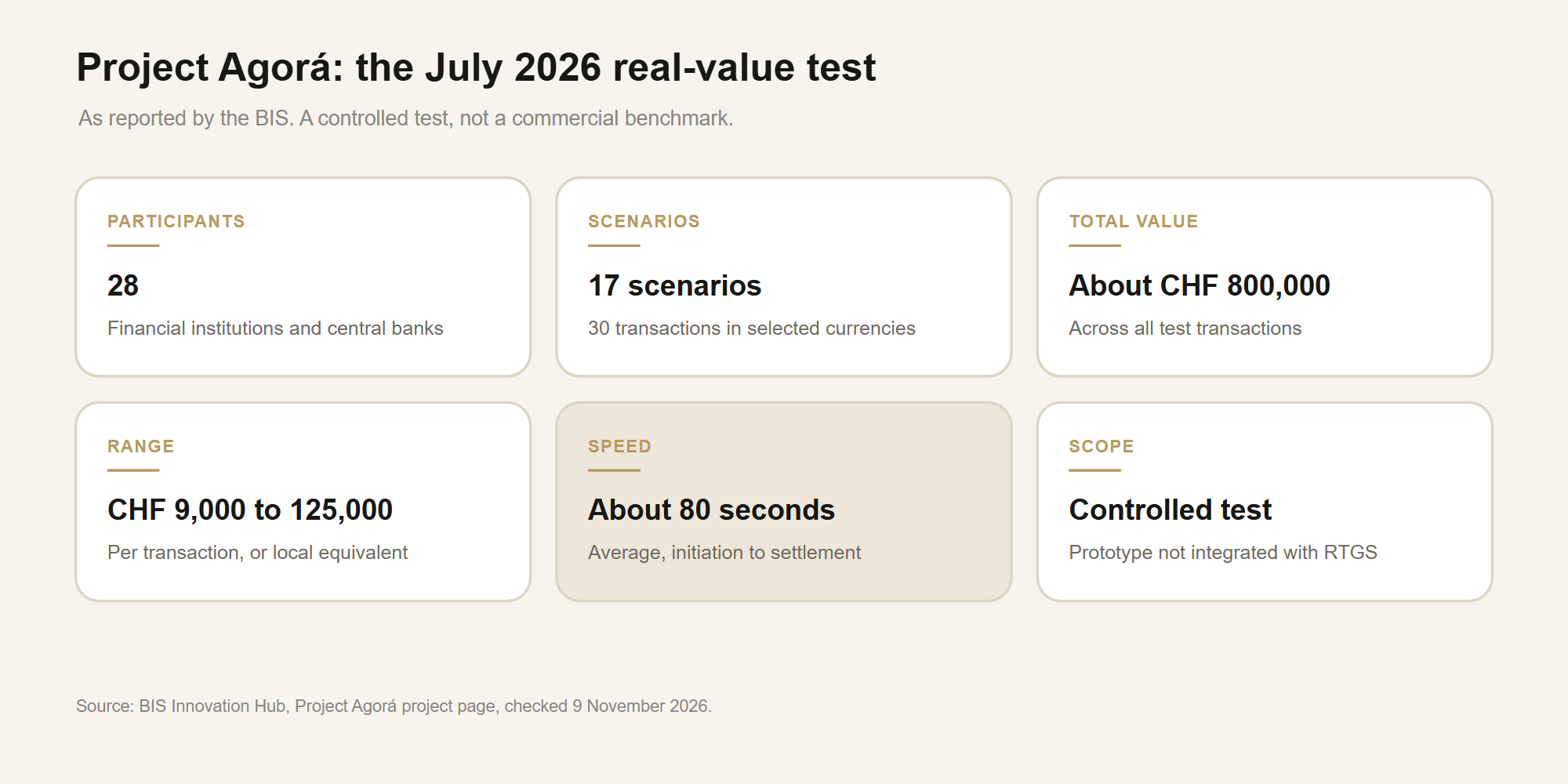
The BIS reported (opens in a new tab) that real-value testing in July 2026 involved 28 financial institutions and central banks. Participants completed 30 transactions across 17 scenarios in selected currencies, totalling approximately CHF 800,000. Transaction values ranged from CHF 9,000 to CHF 125,000 or local-currency equivalents. The average time from payment initiation to settlement was approximately 80 seconds.
These figures are useful evidence of technical and operational feasibility, but they need careful interpretation. This was a controlled test, not a live global network processing billions of dollars each day. The prototype itself was not integrated with existing real-time gross settlement (RTGS) and core banking systems, although the test transactions did interact with them. Its results should not be presented as a proven end-to-end commercial service-level benchmark.
The more important finding is that the test covered real-value transactions and operational, technical, governance and legal considerations. It included corporate and interbank payments, payment-versus-payment transactions and intragroup transfers. It also used established ISO 20022 messaging standards to interact with external systems.
What this means: tokenisation is being tested as a way to improve the existing institutional model, not merely as a replacement for it.
 View the image full size
3. SWIFT is not standing still
One of the most revealing developments came from SWIFT itself. On 9 July 2026, SWIFT announced (opens in a new tab) that its blockchain-based ledger was ready for initial use. Seventeen banks from six continents were preparing to pilot live transactions using tokenised deposits for 24/7 cross-border payment availability and improved liquidity efficiency. Banks issue the tokenised deposits on their own ledgers; the SWIFT ledger coordinates their movement, and final settlement is still completed through existing systems. The banks named by SWIFT include ANZ, BNP Paribas, Citi, DBS, HSBC, OCBC, Standard Chartered, UBS and UOB.
This is significant because SWIFT is often portrayed as the incumbent that blockchain intends to displace. In reality, SWIFT is exploring how a shared ledger could extend its trusted global network and connect tokenised bank money across institutions.
It is important to distinguish messaging from settlement. SWIFT's historic role is primarily the secure exchange of financial messages and instructions. It is not itself the currency being transferred. A blockchain-based ledger is a new infrastructure component; it does not mean that every payment obligation, liquidity arrangement, compliance check or local payout is solved by one network.
The strategic signal is clear: established financial infrastructure providers are not simply defending legacy systems. They are testing how to incorporate new forms of digital value while preserving institutional access, standards and trust.
4. Southeast Asia: the next testing ground?
The regional story is especially relevant to businesses operating across ASEAN.
On 23 October 2026, the Monetary Authority of Singapore announced (opens in a new tab) that Bank Negara Malaysia and the Bank of Thailand had joined its BLOOM initiative as policymaker members. BLOOM stands for Borderless, Liquid, Open, Online, Multi-currency. It brings policymakers, financial institutions, payment networks and technology providers together to develop common approaches for cross-border digital money.
The initiative focuses on three practical questions:
- How can different forms of digital money be accepted and settled across jurisdictions?
- How can separate networks and digital-money arrangements interoperate?
- How can programmable controls such as identity verification, sanctions screening and transaction controls be applied?
The participant group includes banks, payment firms, technology providers and the World Bank Group. This is not a declaration that a single ASEAN digital currency or unified payment network has been launched. It is a coordinated effort to address the commercial, operational and supervisory arrangements required for digital money to move across borders.
Malaysia has its own domestic experimentation programme. In February 2026, BNM announced (opens in a new tab) that its Digital Asset Innovation Hub had onboarded three initiatives to test ringgit stablecoins and tokenised deposits for wholesale payments, including domestic and cross-border transactions and settlement of tokenised assets. BNM said it intended to provide greater clarity on the use of ringgit stablecoins and tokenised deposits by the end of 2026.
BNM's published DAIH information (opens in a new tab) identifies Standard Chartered Bank Malaysia and Capital A for ringgit stablecoins in B2B settlement, Maybank for tokenised deposits for payments, and CIMB for tokenised deposits in tokenised-securities settlement. These are controlled initiatives, not a general authorisation for any company to issue a ringgit stablecoin or take deposits.
 View the image full size
For Malaysia, the implications could extend beyond crypto trading. Tokenised money may eventually support corporate treasury, trade finance, supply-chain payments, settlement of tokenised securities and cross-border business transactions. But practical adoption will depend on licensing, foreign-exchange policy, AML/CFT controls, deposit-taking rules, payment regulation and the legal treatment of the underlying claims.
5. Three forms of digital money, three different risk profiles
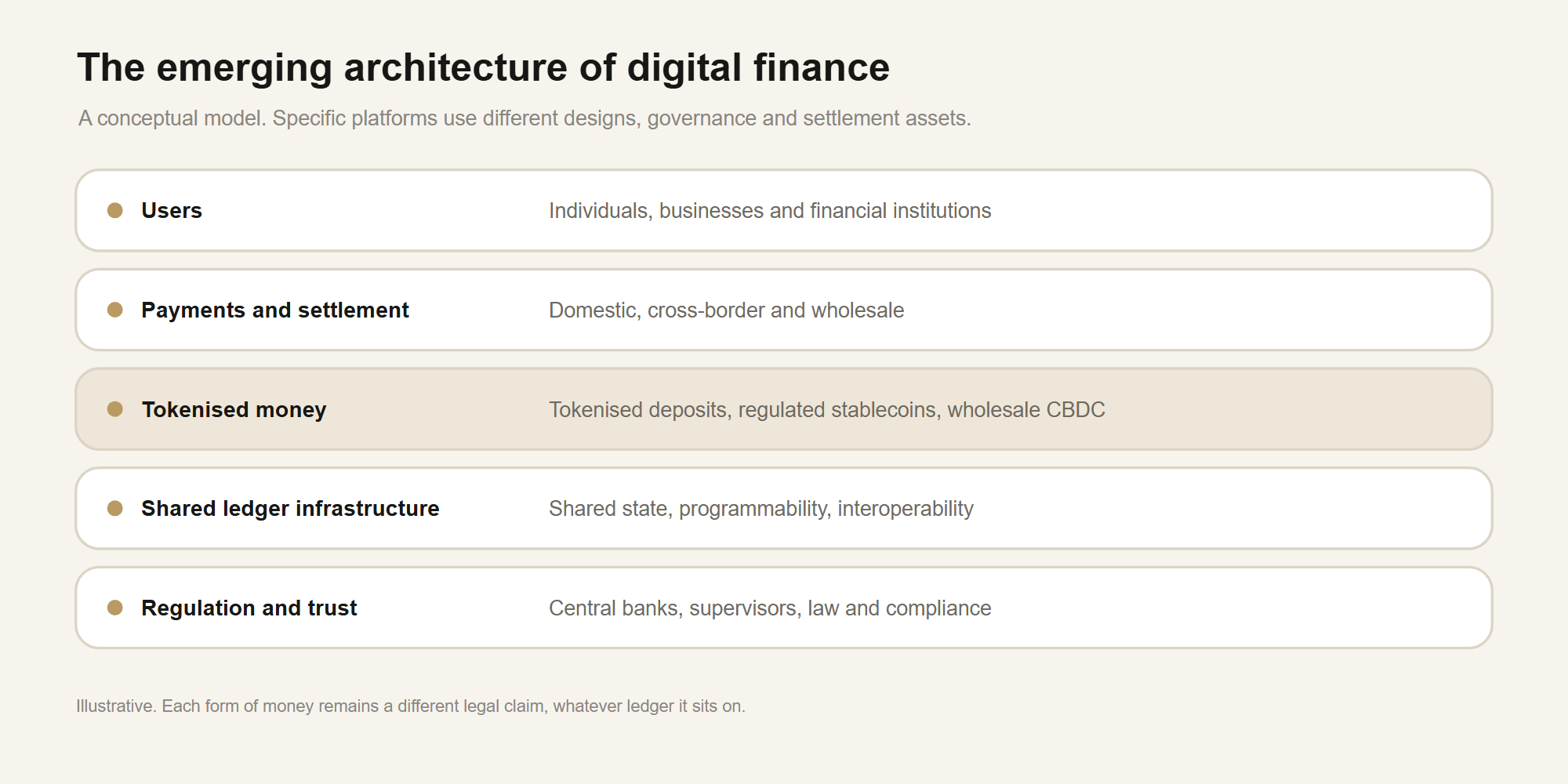
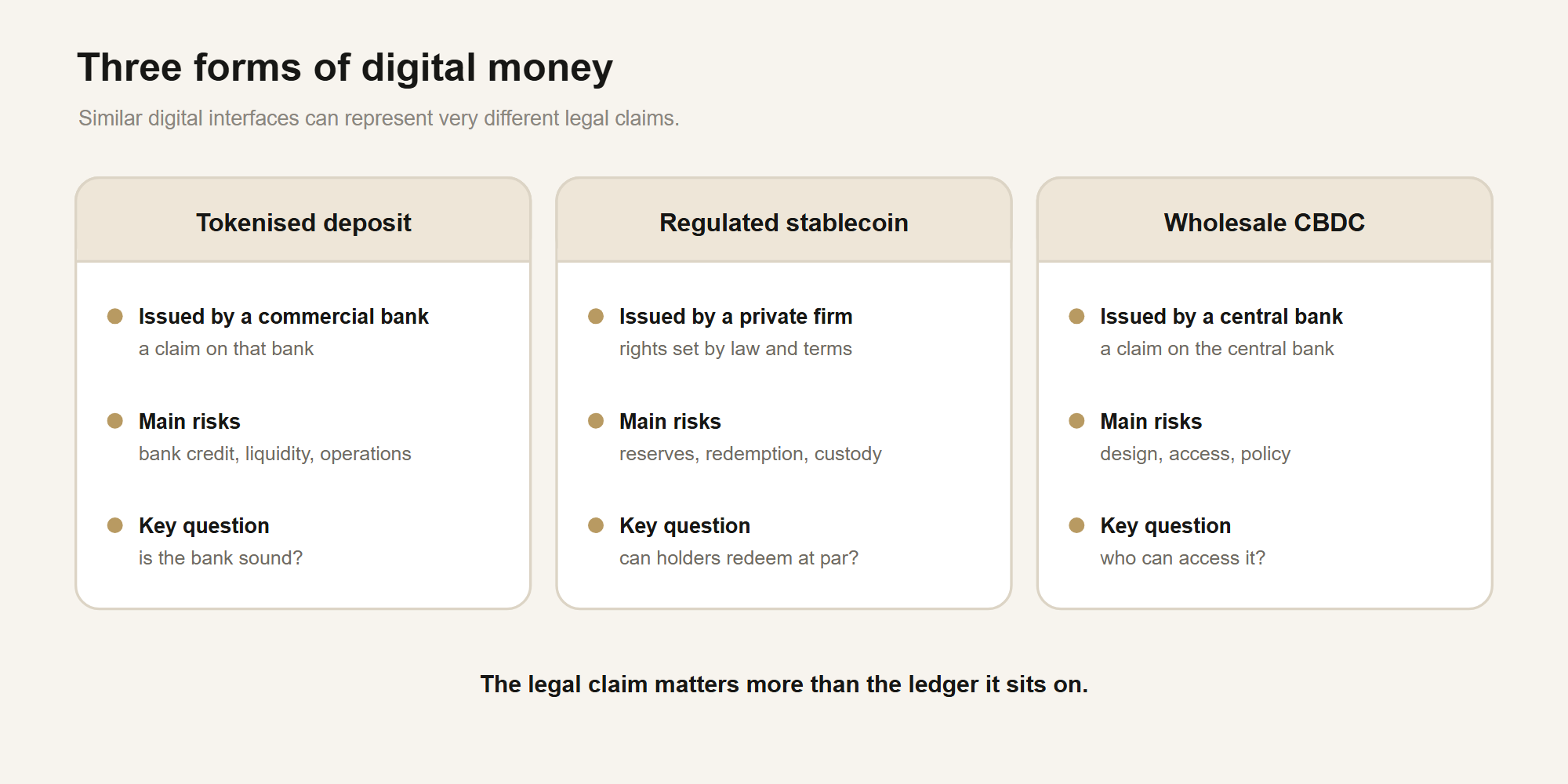
The phrase “digital money” can conceal important differences. A tokenised deposit, a regulated stablecoin and a wholesale central-bank digital currency may all use digital ledgers, but they do not represent the same liability.
| Feature | Tokenised deposit | Regulated stablecoin | Wholesale CBDC |
|---|---|---|---|
| Issuer | Commercial bank | Private issuer authorised under applicable law | Central bank |
| Core claim | Claim on the commercial bank | Claim defined by issuer terms and law | Claim on the central bank |
| Main risk | Bank credit, operational and liquidity risk | Reserve, redemption, issuer, custody and operational risk | Design, access, operational and policy risk |
| Typical role | Bank payments and settlement | Digital-value transfer and settlement, depending on rules | Wholesale settlement between eligible institutions |
| Key question | Is the bank sound and the deposit legally recognised? | Can holders redeem, and what assets and rights support the token? | Who can access it and how does it connect to existing money? |
The legal claim matters more than the user interface. A tokenised deposit does not become a central-bank liability because it is recorded on a blockchain. A stablecoin is not a bank deposit simply because it targets a fiat currency. A wholesale CBDC is not necessarily available to households or ordinary businesses.
 View the image full size
6. The economics: where efficiency could come from
Cross-border finance is not slow for one single reason. A payment can be delayed by incomplete information, compliance reviews, correspondent-bank cut-off times, currency conversion, liquidity constraints, local clearing windows or manual reconciliation. Tokenisation cannot automatically eliminate all of these.
Its potential economic value comes from reducing duplicated work and coordinating multiple obligations more closely.
 View the image full size
Atomic settlement. In a delivery-versus-payment transaction, the transfer of a security and the corresponding payment can be linked so that one does not complete without the other. This can reduce principal risk and the need for lengthy reconciliation, provided the legal and operational design supports finality.
Liquidity efficiency. Better visibility and more continuous settlement may help institutions manage intraday liquidity and reduce the time funds are tied up in processing. This is a potential benefit, not a guarantee that banks can operate with less liquidity in every circumstance.
Programmable workflows. Payment conditions can be encoded into transaction processes. A supplier payment might be released after an agreed event, or collateral might move when specified conditions are met. The quality of the underlying data and the governance of the code become critical.
Operational reconciliation. A shared transaction state may reduce the need for each party to compare separate records after the fact. However, institutions still need to reconcile the ledger with core banking systems, accounting records and legal books.
The BIS Agorá prototype offers a real-value example of these capabilities. Its approximately 80-second average settlement time is promising within the test environment, but it should not be directly compared with a typical consumer remittance or every correspondent-banking corridor. Those transactions differ in compliance, currency, access, liquidity and payout requirements.
7. What could go wrong? The risks behind the architecture
Tokenisation changes the location and shape of risk. It does not make risk disappear.
Legal uncertainty and settlement finality
A system can record a transaction as complete while the legal status of that transaction remains unclear across jurisdictions. Rules must establish which ledger entry is authoritative, when settlement is final, how errors are handled and what happens if a participant becomes insolvent.
Liquidity and maturity mismatch
Digital transfer can happen around the clock, but the assets backing a liability may not be available around the clock. If a tokenised claim can be transferred instantly while redemption depends on banking hours or asset liquidation, a mismatch can emerge during stress.
Operational concentration
A shared platform can reduce fragmented processes but may create concentration around a small number of technology providers, validators, cloud services, identity systems or governance bodies. A platform outage can become a multi-institution event.
Cybersecurity and smart-contract risk
Smart contracts can automate payment logic, but bugs, compromised keys, malicious updates or flawed external data can produce losses. Code audits are necessary but cannot replace operational controls, change management, incident response and recovery testing.
Privacy and data governance
A shared ledger must provide enough transparency for compliance and audit without exposing commercially sensitive information. Privacy-preserving technology can help, but it introduces complexity and must be assessed against local data-protection and supervisory requirements.
Interoperability risk
Connecting networks is not simply a technical bridge problem. Institutions must agree on asset definitions, legal rights, identity standards, operating hours, settlement rules, dispute processes and responsibility for failed transactions.
The Financial Stability Board has warned (opens in a new tab) that tokenisation could create vulnerabilities involving liquidity and maturity mismatch, leverage, asset quality, interconnectedness and operational fragilities. It judged that tokenisation's scale was still limited in its October 2024 report, but noted that vulnerabilities could become more consequential if adoption grows significantly or complexity and opacity increase.
8. Regulation: the rules are part of the infrastructure
The next phase will be shaped as much by regulators as by software developers.
In Malaysia, BNM's Digital Asset Innovation Hub provides a controlled environment for selected real-world use cases. BNM has stated (opens in a new tab) that participants must meet relevant regulatory expectations, including AML/CFT and foreign-exchange policies, and that launching a solution in a live environment would need further assessment by BNM. The Securities Commission Malaysia has a separate capital-market remit for regulated digital-asset activities. Businesses must identify which authority and laws apply to each activity rather than assume that participation in a pilot is a general licence.
In Singapore, BLOOM is a collaborative initiative to develop approaches for digital money across jurisdictions. Its stated focus includes acceptance and settlement, interoperability and programmable controls. Participation in BLOOM should not be confused with blanket regulatory approval for every product offered by a participant.
At the international level, the BIS and participating central banks are examining how tokenised commercial-bank deposits can interact with central-bank reserves while preserving the two-tier monetary system, a point BIS Deputy General Manager Andréa Maechler made in remarks at Sibos in September 2026 (opens in a new tab). That is an important policy choice: innovation in the settlement layer does not necessarily require removing commercial banks from money creation or central banks from the settlement foundation.
9. What changes for businesses and financial institutions?
For corporates, the immediate question is not whether to move every payment onto a blockchain. It is whether a specific workflow has a measurable problem that tokenisation can solve.
Potential use cases include:
- Cross-border treasury transfers between known counterparties.
- Supplier payments linked to verified delivery milestones.
- Trade-finance disbursements and conditional release of funds.
- Settlement of tokenised securities using delivery-versus-payment.
- Intragroup liquidity transfers across subsidiaries.
- Wholesale foreign-exchange payment-versus-payment arrangements.
Before adopting a solution, institutions should assess at least eight areas:
- Legal claim: Identify the issuer, governing law, holder rights, insolvency treatment and authoritative record.
- Settlement finality: Establish when the payment becomes irrevocable and how conflicting records are resolved.
- Liquidity: Confirm funding hours, redemption channels, currency conversion and contingency liquidity.
- Compliance: Map KYC, sanctions, AML/CFT, transaction monitoring, record retention and data-sharing obligations.
- Technology: Assess key management, smart-contract controls, network resilience, access permissions and recovery.
- Interoperability: Confirm standards, APIs, messaging formats and compatibility with core banking and accounting systems.
- Governance: Define who can change rules, pause operations, reverse erroneous actions or resolve disputes.
- Economics: Compare the complete end-to-end cost, including integration, custody, compliance, FX spreads, liquidity and local payout.
A sensible approach is to begin with a narrow, high-value use case. Establish approved counterparties, transaction limits, wallet or account controls, exception handling and reconciliation procedures. Measure the full process, not merely the time taken for an on-chain transfer.
10. The future: a hybrid financial system
It is tempting to predict that one technology will replace all others. The evidence points in a different direction.
Commercial-bank deposits are likely to remain central to business and household finance. Tokenised deposits may give banks new ways to move those liabilities. Regulated stablecoins may serve particular payment and settlement needs where their legal and reserve structures are appropriate. Central-bank money will remain important as the ultimate settlement asset for eligible institutions. Existing payment networks and national systems will continue to provide reach, identity, compliance and local-currency access.
The future challenge is interoperability: making different forms of money and different systems work together without weakening legal certainty, monetary sovereignty or financial stability.
For Southeast Asia, this is more than a technology story. The region's trade links, remittance corridors, diverse currencies and different regulatory regimes create a real incentive to improve cross-border settlement. BLOOM and BNM's domestic testing are early steps in a broader institutional process. Their success will depend on common standards, clear liability, reliable conversion and the willingness of banks and payment providers to integrate.
Conclusion: the next banking revolution may happen inside the banks
Blockchain began as a challenge to centralised financial infrastructure. Its next major chapter may be its integration into the institutions that already hold deposits, manage liquidity and settle financial obligations.
Project Agorá, SWIFT's tokenised-deposit ledger initiative and Southeast Asia's BLOOM collaboration all point towards a gradual redesign of the financial operating layer. None proves that a fully tokenised global banking system is imminent. Each demonstrates that major institutions are testing how digital representation, programmability and shared settlement can improve specific parts of the system.
The winners will not necessarily be the organisations with the most tokens or the fastest blockchain. They will be those that combine technology with enforceable legal rights, sound liquidity, resilient operations, interoperability and credible governance.
The future of finance may not be banks versus blockchain. It may be banking rebuilt around blockchain-enabled infrastructure.
The most consequential change may not be who issues money, but how money moves, settles and connects across the financial system.
Frequently asked questions
Are banks replacing their existing systems with blockchain? Not wholesale. Current projects are prototypes, pilots or new infrastructure components designed to connect with existing banking systems. Integration, legal recognition and operational resilience remain essential.
What is a tokenised bank deposit? It is a digital representation of a deposit liability issued by a commercial bank. The underlying claim remains against that bank and is not transformed into central-bank money by tokenisation.
Is a tokenised deposit the same as a stablecoin? No. A tokenised deposit is a claim on a commercial bank. A stablecoin is a digital token whose claim, reserves and redemption rights depend on its issuer and the applicable legal framework.
Does Project Agorá prove cross-border payments can settle in 80 seconds? It demonstrates that an average of about 80 seconds was achieved in the project's controlled real-value testing. It is not a universal commercial benchmark or a guarantee for every currency corridor and payment type.
Is SWIFT being replaced by blockchain? There is no evidence that SWIFT is being replaced. SWIFT is developing a blockchain-based ledger as an additional infrastructure component and is preparing pilots with banks using tokenised deposits.
What is Malaysia doing in this area? BNM's Digital Asset Innovation Hub is testing ringgit stablecoins and tokenised deposits for wholesale payment and tokenised-asset settlement use cases. Malaysia has also joined Singapore and Thailand in the BLOOM initiative to explore cross-border digital-money arrangements.
What is the biggest risk? There is no single risk. Legal finality, liquidity, operational concentration, cybersecurity, privacy, interoperability and governance must all be addressed together.
Sources and Further Reading
BIS Innovation Hub, "Project Agorá", project page, checked 9 November 2026. The project's eight central banks and more than 40 financial institutions, and the July 2026 real-value test: 28 financial institutions and central banks, 17 scenarios, 30 transactions, about CHF 800,000 in total, CHF 9,000 to 125,000 per transaction and an average of about 80 seconds from initiation to settlement. Read the project page (opens in a new tab).
Bank for International Settlements, "Project Agorá: a shared programmable platform for wholesale cross-border payments", BIS Innovation Hub project report, 27 May 2026. The prototype's design and its technical, legal and operational findings. Read the report (opens in a new tab).
Bank for International Settlements, "Project Agorá shows how tokenisation can improve wholesale cross-border payments; work will advance to real-value testing", 27 May 2026. The participating central banks, the finding that tokenisation does not change the legal status of reserves or deposits, and the plan for real-value testing. Read the media release (opens in a new tab).
Swift, "Swift's blockchain ledger ready for use as 17 banks set to pioneer tokenised cross-border payments on trusted global infrastructure", 9 July 2026. The 17 pilot banks from six continents, 24/7 payments with tokenised deposits, and final settlement through existing systems. Read the press release (opens in a new tab).
Monetary Authority of Singapore, "MAS, Bank Negara Malaysia and Bank of Thailand Partner with Industry to Advance Cross-Border Settlement in Digital Money through BLOOM", 23 October 2026. BNM and the Bank of Thailand joining as policymaker members, BLOOM's three focus areas and its participants, including the World Bank Group. Read the media release (opens in a new tab).
Monetary Authority of Singapore, "BLOOM", 23 October 2026. The initiative's aim to advance next-generation settlement infrastructure for domestic and cross-border payments. Read the overview (opens in a new tab).
Bank Negara Malaysia, "Digital Asset Innovation Hub Charts 2026 Strategy with Focus on Ringgit Stablecoins and Tokenised Deposits", 11 February 2026. Three initiatives testing ringgit stablecoins and tokenised deposits for wholesale payments, and BNM's aim to give greater clarity by the end of 2026. Read the press release (opens in a new tab).
Bank Negara Malaysia, "Digital Asset Innovation Hub (DAIH)", updated 30 July 2026. The named initiatives, the expectations on AML/CFT and foreign-exchange policy, and the further assessment needed before any live launch. Read the page (opens in a new tab).
Financial Stability Board, "The Financial Stability Implications of Tokenisation", 22 October 2024. Liquidity and maturity mismatch, leverage, asset quality, interconnectedness and operational fragilities. Read the report (opens in a new tab).
Andréa M Maechler, Deputy General Manager, Bank for International Settlements, "Big issues debate: The sovereign money question: CBDCs, stablecoins, and the fight for the settlement layer", remarks at Sibos, Miami, 29 September 2026. Tokenisation in wholesale payments and preserving the two-tier monetary system. Read the remarks (opens in a new tab).
Editorial note
This article is for general information and education. It is not investment, legal, tax or regulatory advice, and it does not recommend any digital asset, issuer, payment network or technology provider.
Project announcements, pilots and controlled tests are not proof of commercial readiness, and they are not regulatory approval for unrelated products. The Project Agorá figures describe a controlled real-value test, not market-wide adoption. Readers should consult the primary documents and qualified advisers before making financial, legal or operational decisions.
Sources last checked on 9 November 2026.